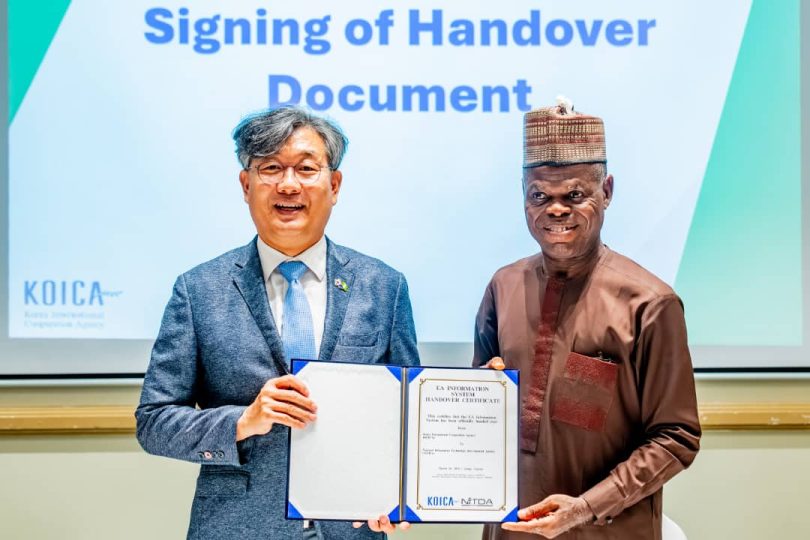
Nigeria has advanced its digital governance agenda with the formal handover of the Nigeria Government Enterprise Architecture (NGEA) Portal to the National Information Technology Development Agency.
Director-General of NITDA, Kashifu Inuwa Abdullahi, described the development as a strategic milestone in the country’s digital transformation efforts.
The project was implemented under Nigeria’s e-Government Masterplan 2.0 in partnership with the Republic of Korea through the Korea International Cooperation Agency.
Abdullahi, represented at the event by Dr Dimie Warowei, said the initiative is designed to enhance coordination, efficiency and interoperability across government institutions.
“The successful implementation of enterprise architecture will reduce duplication and improve service delivery,” he said.
The initiative, which began in 2022, involved collaboration between Nigerian and Korean experts to upgrade the country’s enterprise architecture framework.
Key outputs include Technology, Business and Service Reference Models, with additional Data and Performance Models expected to strengthen implementation.
Pilot programmes were conducted in selected MDAs, including the National Identity Management Commission, Nigeria Customs Service, Nigeria Immigration Service and NITDA.
These agencies received capacity-building support and customised digital transformation plans.
The infrastructure supporting the portal was developed by Qorebox Technologies and hosted by Galaxy Backbone.
A two-year maintenance plan has also been established.
In his remarks, KOICA Country Director, Eunsub Kim, described the project as a successful outcome of international collaboration.
He reaffirmed the agency’s commitment to supporting Nigeria’s digital transformation.
Also speaking, the Permanent Secretary of the Ministry of Communications, represented by Johnson Bareyei, said the initiative marks a transition from fragmented systems to a coordinated framework.
He added that the project aligns with the ministry’s agenda under Bosun Tijani.
Experts say the development will enhance public sector efficiency and strengthen digital service delivery nationwide.
Nigeria Deepens Digital Reform as NITDA Takes Over NGEA Portal