
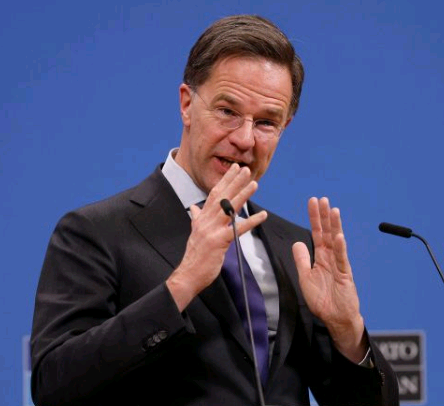
According to an Anadolu English report of Tuesday 3 of March 2026, the Secretary General of North Atlantic Treaty Organization (NATO), Mark Rutte, has said that the group is not involved in the latest escalation in the Middle East, but warned that Iran’s expanding nuclear and ballistic missile capabilities represent a growing danger to both regional and European security.
Rutte made the remarks during a joint press conference in Skopje with North Macedonian President, Gordana Siljanovska-Davkova, as tensions continue to rise, following recent military developments in the region.
Responding to questions about the unfolding crisis, Rutte emphasized that the alliance is monitoring events closely but is not a direct participant.
“NATO is not itself involved,” Rutte said.
He then issued a strong warning about Tehran’s military trajectory.
“But let’s be absolutely clear. Iran is close to getting his hands on a nuclear capability and on a ballistic missile capability which is posing a threat, not only to the region, the Middle East, including posing an existential threat to Israel. It is also posing a use threat to us here in Europe,” he added.
Rutte described Iran as “an exporter of chaos,” accusing it of being responsible for “terrorist attacks and assassination attempts” over several decades.
The comments come as tensions have surged since the United States (US) and Israel launched a large-scale attack on Iran over the weekend. The strikes reportedly killed nearly 800 people, including Supreme Leader, Ayatollah Ali Khamenei. Tehran has since responded with drone and missile attacks aimed at Israel and several Gulf states hosting U.S. military assets.
Turning to alliance priorities, Rutte urged member states to step up defence spending and accelerate industrial output to meet agreed capability targets and properly fund NATO’s missions.
“This is no time to be complacent; all allies have to do more,” he said, arguing that higher defence investment would strengthen security while also supporting economic growth and employment.
Rutte also highlighted the role of NATO’s Kosovo Force, saying that the mission remains central to maintaining stability in Kosovo, and would stay “robust and fit for purpose.”
Siljanovska-Davkova, meanwhile, said that integrating the Western Balkans into the European Union would represent the strongest long-term investment in security for both Europe and the region.See_More…