
Exclusive Investigation: Revenue Agency Spent Almost N11.5bn on Local and International Training in 2024 Alone
Domestic Travel Rose by N1.4bn, International Travel Hit Nearly N2bn as Nigerians Battled Inflation
By NaijaonpointOnline Investigations Desk
At a time when millions of Nigerians were struggling with soaring food prices, naira depreciation and the rising cost of living, the Federal Inland Revenue Service (FIRS), under the leadership of Executive Chairman Zacchaeus Adelabu Adedeji, recorded billions of naira in expenditure on training, travel, retreats and other operational activities.
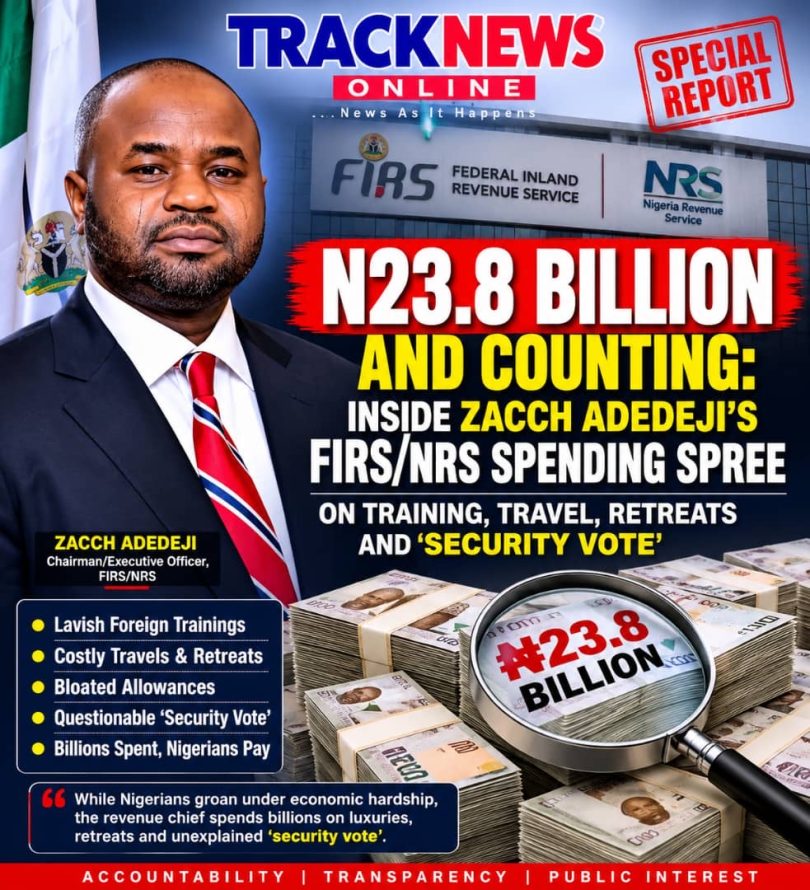
An examination of the figures reviewed by NaijaonpointOnline shows that expenditure under several of these headings amounted to more than N23.8 billion, raising questions about spending priorities, value for money and the level of accountability surrounding the management of public resources at the nation’s revenue authority.
The figures cover expenditure attributed to FIRS/NRS during the period under review and include local and international training, domestic and international travel, operational meetings and retreats, as well as an expenditure line described as a “security vote.”
The scale of the spending is particularly striking when compared with the remuneration of the agency’s chief executive and the economic hardship experienced by ordinary Nigerians during the same period.
N11.5 BILLION ON TRAINING IN ONE YEAR
One of the biggest expenditure lines identified in the records is training.
In 2024 alone, FIRS/NRS reportedly spent N7,495,004,001 on local training against an approved provision of N7,500,415,000.
That means virtually the entire approved allocation was spent.
The agency also reportedly spent N3,999,126,790 on international training during the same year against an approved N4 billion.
Taken together, local and international training expenditure came to approximately N11.49 billion in 2024.
The figures raise an obvious accountability question: what programmes, personnel and measurable institutional outcomes justified nearly N11.5 billion in training expenditure in a single year?
Training is an important component of institutional development, particularly for a revenue agency operating in an increasingly digital and complex tax environment.
But the size of the expenditure makes transparency essential.
The public deserves to know the number of beneficiaries, training providers, locations, contracts, procurement processes and measurable outcomes associated with the spending.
TRAVEL BILL CROSSES N6 BILLION
Travel expenditure also increased significantly.
Domestic travel expenditure reportedly rose from N2,615,597,469 in 2023 to N4,032,066,993 in 2024.
That represents an increase of approximately N1.42 billion in one year.
International travel also increased.
The agency reportedly spent N1,249,687,891 on international travel in 2023, before the figure climbed to N1,999,937,977 in 2024.
Combined domestic and international travel expenditure therefore amounted to approximately N6.03 billion in 2024.
The figures prompt another important question:
How many trips were undertaken, by whom, for what purposes and at what cost to the public purse?
For an agency whose central responsibility is revenue collection, every naira spent on official travel should ultimately be capable of being connected to a legitimate institutional objective.
THE N2.26 BILLION RETREAT AND MEETING BILL
The spending does not end with training and travel.
In 2024, approximately N2,264,143,659 was reportedly spent under the heading of “operational meetings and retreats.”
The expenditure was against an approved provision of N2.5 billion.
Again, the scale of the spending raises questions about the frequency, locations, participants and costs associated with the meetings and retreats.
How many retreats were held?
How many officials attended?
What hotels, venues and service providers were engaged?
What procurement processes were followed?
And most importantly, what measurable institutional benefits resulted from the expenditure?
These are questions that should be answered by any public institution spending billions of naira.
THE ₦140 MILLION ‘SECURITY VOTE’ QUESTION
Perhaps the most contentious figure is the reported N140 million expenditure under a “security vote” line in 2024, against an approved allocation of N262.5 million.
The terminology deserves particular scrutiny.
Security votes are commonly associated with discretionary security-related spending by state governors and are subject to longstanding debates over transparency and accountability.
If the FIRS/NRS records indeed classify N262.5 million as an approved “security vote” allocation, with N140 million reportedly spent, the agency should explain the legal and administrative basis for the expenditure.
Who authorised it?
What was the statutory basis?
Who received the funds?
What services were provided?
Were the payments made through normal procurement and financial-control procedures?
These questions are not accusations of wrongdoing. They are basic accountability questions concerning public expenditure.
THE CHAIRMAN’S OWN REMUNERATION
The spending figures become even more striking when placed alongside the remuneration attributed to the agency’s leadership.
In 2023, Adedeji’s reported annual salary was N54,878,485, alongside a 30 percent subsistence allowance of N16,463,546.
By 2024, his reported salary had risen to N84,812,204.
That represents an increase of nearly N30 million in annual salary.
The increase occurred during a period when Nigerians were facing severe economic pressures and the government was working through reforms to establish a new national minimum wage.
The issue is not whether a senior public official should be properly remunerated.
Rather, the question is whether remuneration and institutional expenditure are being matched by adequate transparency, performance reporting and value for money.
N23.8 BILLION: WHERE DID THE MONEY GO?
When the major expenditure categories are put together, the numbers become difficult to ignore.
Local and international training: approximately N11.49 billion
Domestic and international travel: approximately N6.03 billion
Operational meetings and retreats: approximately N2.26 billion
Reported security-vote expenditure: N140 million
Other expenditure captured within the reviewed figures brings the overall spending examined by NaijaonpointOnline to more than N23.8 billion.
The sheer size of the figure demands more than political commentary.
It demands documentation.
It demands disclosure.
And it demands an explanation of the value Nigerians received in return.
REVENUE COLLECTION VS. SPENDING PRIORITIES
FIRS/NRS occupies a unique position in Nigeria’s financial architecture.
It is responsible for collecting federal taxes and mobilising revenue needed to fund government programmes, infrastructure, security, healthcare, education and other public services.
That makes financial discipline at the agency particularly important.
Every naira spent by a revenue authority is ultimately a naira that must be justified to the Nigerian public.
The central question arising from the figures is therefore not simply “how much was spent?”
It is:
“What did Nigerians get for the money?”
If billions were spent on training, the agency should be able to demonstrate improved tax administration, stronger compliance, enhanced technology, better staff capacity and increased revenue efficiency.
If billions were spent on travel, the public should be able to see the official purposes and outcomes.
If billions went into meetings and retreats, there should be documented deliverables.
And if a “security vote” existed within the agency’s expenditure framework, its legal authority and disbursement mechanisms should be transparent.
TRACKNEWS ONLINE QUESTIONS
Based on the figures reviewed, NaijaonpointOnline is seeking clarification from FIRS/NRS on the following:
1. What specific programmes accounted for the nearly N11.5 billion training expenditure in 2024?
2. How many FIRS/NRS officials benefited from local and international training?
3. Which companies, consultants, hotels and training institutions received the funds?
4. What was the procurement process for the training contracts?
5. What accounted for the more than N6 billion travel expenditure in 2024?
6. How many domestic and international trips were undertaken?
7. What was the total number of officials involved and the average cost per trip?
8. What activities accounted for the N2.26 billion spent on operational meetings and retreats?
9. What is the statutory basis for the reported N140 million security-vote expenditure?
10. Who approved and received the security-related payments?
11. What audit mechanisms were applied to the expenditure?
12. What measurable outcomes did the spending produce for taxpayers and the Nigerian government?
THE ACCOUNTABILITY TEST
This investigation is not an argument against legitimate government expenditure.
A modern revenue authority needs trained personnel. It needs technology. Its officials may need to travel. Meetings and retreats can be necessary. Security expenditure can also be legitimate where properly authorised.
But legitimate expenditure and accountable expenditure must go together.
When an agency spends billions of naira, Nigerians have the right to know what was purchased, who received the money, why it was necessary and what result it produced.
The figures reviewed by NaijaonpointOnline therefore raise a fundamental question about the stewardship of public funds under Zacchaeus Adelabu Adedeji:
At a time when Nigerians were being asked to make economic sacrifices, was the revenue authority exercising the same level of financial restraint?
Until the agency provides detailed explanations and supporting documentation, the N23.8 billion expenditure figure will remain a major public-interest accountability issue.
NaijaonpointOnline will continue to examine the records, follow the money and seek responses from the relevant authorities.
NaijaonpointOnline welcomes a response from FIRS/NRS and will publish any substantive clarification or rebuttal received.