

Nigeria’s Minister of Power, Adebayo Adelabu, has debunked reports claiming he resigned from office to pursue the Oyo State governorship race.
The denial was issued by his Special Adviser on Strategic Communications and Media, Bolaji Tunji, who clarified that the minister remains in office.
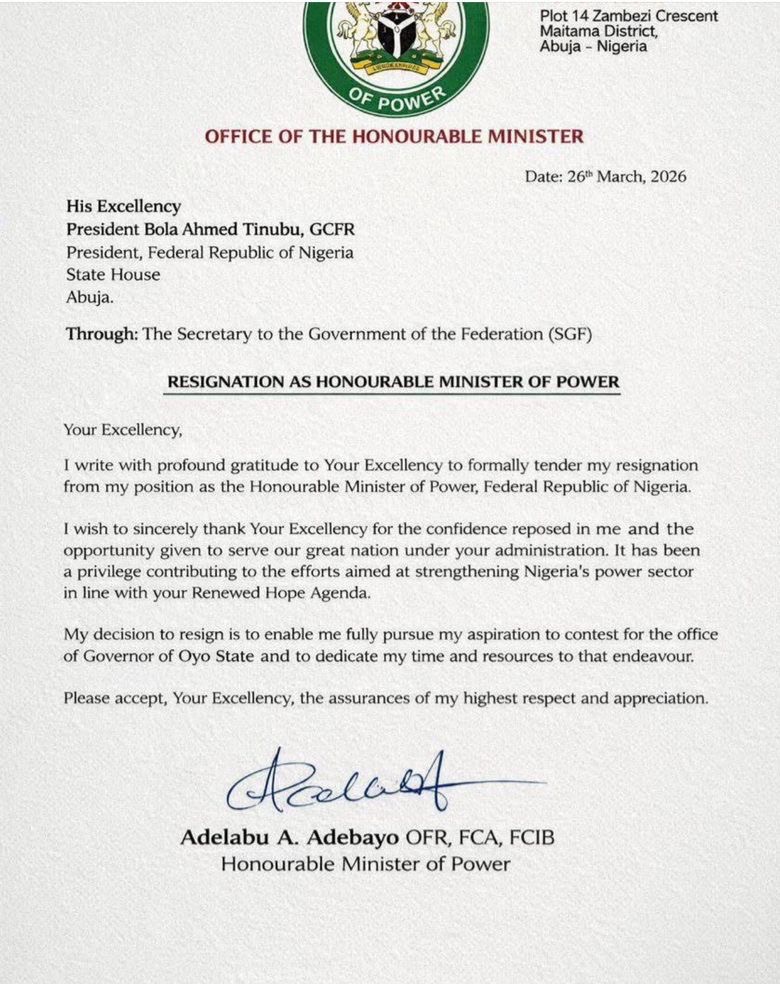
Reports of Adelabu’s alleged resignation surfaced online on Tuesday, coinciding with the deadline set by Bola Tinubu for political appointees seeking elective positions to step down from their roles.
Responding to the resignation claims on Tuesday, Tunji dismissed the reports as false, insisting that the minister is still fully engaged in his duties.
In the purported resignation letter, which Tunji has now described as ‘fake news’, Adelabu, while thanking the President, stated that his decision to resign was to enable him contest in the Oyo State governorship race in 2027.
Recall that President Tinubu, in line with Nigerian electoral law, directed political appointees seeking elective office to resign on or before March 31. Nigeria’s Minister of Foreign Affairs, Yusuf Tuggar, also tendered his resignation to pursue his governorship ambition in Bauchi State ahead of the 2027 general elections.
Additionally, Minister of Transportation, Saidu Alkali, has also resigned from his position to run for the governorship in the 2027 election in Gombe State.
Before now, Adelabu has been linked with the ambition of vying for the Oyo State governorship.
A week ago, during a press briefing in Abuja, he refused to confirm whether he would resign from his position.
His intention to contest was first revealed last June when he met with APC stakeholders in Oyo to declare his interest in the seat, according to media reports.
Despite the denial, and with the expiration of the resignation window set by the President, the speculation has drawn further attention to the state of Nigeria’s power sector, which has faced persistent challenges in recent months, including inconsistent electricity supply linked to gas shortages affecting power generation companies.
The situation has been further compounded by a mounting debt crisis, with GenCos weighed down by an estimated N6.8 trillion in liabilities, forcing some operators to scale down or halt operations.
Last week, Adelabu publicly apologised to Nigerians over the poor state of electricity supply.
Although President Tinubu campaigned on improving electricity supply and appointed Adelabu, a former Deputy Governor of the Central Bank of Nigeria, to drive reforms in the sector, many Nigerians say there has been little improvement.
These challenges persist despite government claims that reforms have attracted about $2 billion in investments and reduced sector liabilities to N146 billion, raising concerns about the pace and effectiveness of ongoing interventions.