
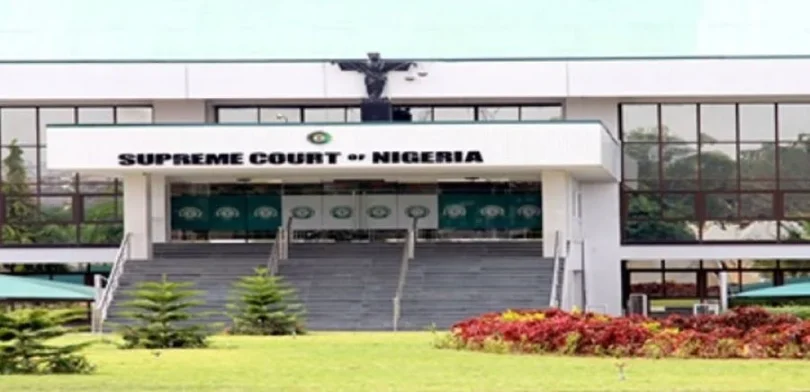
The Nigerian judiciary witnessed a busy and consequential year in 2025, with courts delivering landmark rulings that stirred national debate and reshaped legal and political conversations. While several high-profile cases were concluded, others remained unresolved or are still making their way through the courts.
Below is a recap of some of the most significant court judgements that defined the year.
1. Proscription of Lakurawa as terrorist group
In January, the Federal High Court in Abuja declared the Lakurawa sect a terrorist organisation following a wave of violent attacks in parts of north-west Nigeria.
The group rose to prominence in late 2024 after carrying out deadly assaults on rural communities. One of its most notorious attacks occurred in November 2024, when gunmen invaded Mera village in Augie LGA of Kebbi State, killing no fewer than 15 residents.
The court also proscribed other similar armed groups operating across the north-west and north-central regions.
2. Supreme Court ruling on Rivers political crisis
In February, the Supreme Court nullified the local government election conducted in Rivers State on October 5, 2024.
The apex court ruled that the requirements stipulated under section 150(3) of the Electoral Act were not met before the Rivers State Independent Electoral Commission conducted the polls.
A five-member panel upheld an earlier Federal High Court judgement restraining the Central Bank of Nigeria and the Accountant-General of the Federation from releasing statutory allocations to the state.
The court further ordered the Martins Amaewhule-led faction of the Rivers State House of Assembly and other elected lawmakers to resume legislative sittings.
The judgement was widely interpreted as favouring the camp of Nyesom Wike, minister of the Federal Capital Territory, and dealing a blow to Governor Siminalayi Fubara. The political tussle later escalated into the declaration of emergency rule in the state by President Bola Tinubu in March.
3. Sunday Jackson death sentence
The case of Sunday Jackson continued to generate national outrage in 2025.
Jackson, an Adamawa farmer, was sentenced to death in February 2021 for killing an attacker on his farm, despite pleading self-defence.
According to court records, the incident occurred on January 27, 2015, when an armed herder allegedly attacked Jackson while he was working on his farm. Jackson reportedly overpowered the man, disarmed him and stabbed him.
The trial court ruled that Jackson had the opportunity to flee instead of killing his attacker. This decision was upheld by the Court of Appeal in June 2022 and later affirmed by the Supreme Court in March 2025.
The ruling triggered widespread condemnation, with critics arguing that the courts failed to properly consider Jackson’s self-defence claim.
Public pressure eventually paid off when Adamawa State Governor Ahmadu Fintiri granted Jackson a pardon during the Christmas and New Year celebrations.
4. Appeal Court upholds conviction of lecturer over electoral fraud
In April, the Court of Appeal sitting in Calabar affirmed the conviction of Peter Ogban, a professor of soil science at the University of Calabar, for manipulating election results.
Ogban served as returning officer in the 2019 Akwa Ibom North-West senatorial election and was accused of falsifying results in favour of Godswill Akpabio of the APC.
He was sentenced to three years imprisonment and fined N100,000 by a High Court in Akwa Ibom State in March 2021, a verdict the appellate court upheld.
5. Governors lose bid to reclaim N1.8tn recovered funds
In May, the Supreme Court dismissed a suit filed by the 36 state governments and the Nigeria Governors’ Forum challenging the Federal Government’s handling of recovered looted assets.
The apex court ruled that it lacked jurisdiction, holding that the matter should have been filed at the Federal High Court.
The states had alleged that between 2015 and 2021, the Federal Government recovered looted assets worth N1.836 trillion, alongside properties, vehicles and crude oil, without remitting them into the federation account.
6. Court backs FIRS on VAT collection from ride-hailing platforms
In July, the Federal High Court in Lagos affirmed the authority of the Federal Inland Revenue Service to collect value-added tax on transport and food delivery services offered through platforms such as Bolt.
Justice Akintayo Aluko upheld an earlier ruling by the Tax Appeal Tribunal, which recognised FIRS’ power to appoint digital platforms as VAT collection agents.
The dispute originated in 2022 when operators sought to restrain FIRS from imposing VAT on services rendered via the Bolt platform.
7. Court declares Pat Utomi shadow government illegal
In October, a Federal High Court in Abuja restrained political economist Pat Utomi and his associates from proceeding with plans to establish a shadow government.
Delivering judgement in a suit filed by the Department of State Services, Justice James Omotosho ruled that the idea of a shadow cabinet is unconstitutional and incompatible with Nigeria’s presidential system.
He held that the constitution does not recognise any parallel or alternative government outside the one it establishes.
8. Nnamdi Kanu conviction
In November, Nnamdi Kanu, leader of the proscribed Indigenous People of Biafra, was convicted on terrorism charges by the Federal High Court in Abuja and sentenced to life imprisonment.
Justice James Omotosho imposed life sentences on several counts, alongside additional prison terms of 20 years and five years on other charges.
The judgement concluded Kanu’s long-running trial, which began after his extradition from Kenya to Nigeria in 2021.
9. Supreme Court ruling on Osun LGA funds
In December, the Supreme Court dismissed a suit filed by the Osun State attorney-general against the Federal Government over withheld local government allocations.
In a split six-to-one decision, the court held that the attorney-general lacked the legal standing to sue on behalf of the state’s 30 LGAs.
However, the apex court faulted the Federal Government for withholding the funds, describing the action “as a grave breach” of the constitution.
10. Supreme Court judgement on Rivers emergency rule
On December 15, the Supreme Court delivered its judgement on the declaration of emergency rule in Rivers State and the suspension of democratic institutions by President Tinubu earlier in the year.
The court upheld the president’s constitutional authority to declare a state of emergency to avert a breakdown of law and order and affirmed his power to suspend elected officials for a limited period.
The ruling followed a suit filed by Adamawa State and 10 other PDP-governed states challenging the legality of the emergency declaration.