
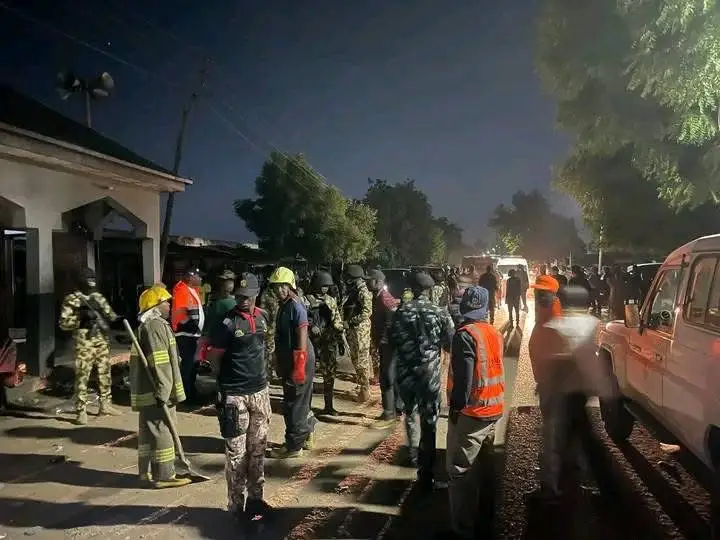
On December 24, 2025, a bomb blast in Maiduguri, the capital of Borno State, claimed the lives of several Muslim worshippers. The explosion occurred in a Muslim community inside a mosque full of worshippers – an area neither Christian nor proximate to any Christian-dominated neighborhood. These facts are not in dispute.
What is in dispute, however, is how the tragedy was framed in sections of the Nigerian media. A number of reports described the incident as a “bomb blast on Christmas Eve,” a formulation that has raised serious concerns about media responsibility in a country where religious and ethnic tensions remain dangerously close to the surface.
In Nigeria, words carry weight far beyond their dictionary meaning. To foreground “Christmas Eve” in reporting an attack whose victims were Muslims and whose location bore no religious connection to Christianity is not merely a neutral reference to time. It is a framing choice – one that risks imposing a sectarian interpretation on an act of violence where none has been established.
Nigeria’s media landscape has a long and complicated history with identity-based reporting. In the years preceding independence and during the First Republic, newspapers often aligned themselves with regional and political blocs. While the press played a vital role in mobilising anti-colonial resistance, it also helped entrench narratives of ethnic and religious suspicion that later contributed to political instability. The collapse of the First Republic and the descent into civil war did not occur in an informational vacuum; they were preceded by years of inflammatory rhetoric and selective framing. That legacy has never been fully confronted.
From the Maitatsine uprisings of the 1980s to the Sharia riots of the early 2000s, from the recurrent crises in Jos and Kaduna to the Boko Haram insurgency, media coverage of violence in Nigeria has frequently relied on simplified identity frames. Complex social, economic and political failures are reduced to clashes between religious or ethnic “communities,” often at the expense of context, evidence and restraint. It is against this historical background that the Maiduguri reporting must be understood. In a deeply polarised society, references such as “Christmas Eve” are not culturally neutral. They carry symbolic and emotional resonance that can shape public perception, fuel resentment and, in extreme cases, encourage retaliatory thinking. The danger lies not in explicit accusations, but in the subtle cues that invite readers to draw their own, often divisive, conclusions.
Global history offers sobering lessons. The Rwandan genocide of 1994 did not begin with mass violence; it was preceded by sustained media narratives that framed events through rigid identity lenses, normalised suspicion and stripped victims of their humanity. While Nigeria’s circumstances are different, the structural warning remains relevant: when the media abandons context and restraint, it can become an accelerant rather than a stabiliser. This places a heavy responsibility on editors and reporters. Journalism in a fragile democracy is not merely about speed or sensational appeal; it is about accuracy, proportionality and an awareness of social consequences. Framing choices must be guided by verified facts, not by symbolic shortcuts that risk inflaming already volatile fault lines.
Media accountability, therefore, is not a professional concern alone – it is a democratic imperative. Ethical lapses in reporting violence should attract more than private criticism; they require public correction, institutional reflection and, where necessary, sanction. Equally important is the role of the audience. In an age of instant sharing, citizens must recognise that circulating incendiary headlines is itself a political act. At moments like this, the Nigerian media must decide what kind of institution it intends to be. A society as fragile and diverse as Nigeria cannot survive a press that treats identity as clickbait and tragedy as spectacle. History has shown – repeatedly and painfully – that when the media fans embers in a divided nation, it does not merely report the fire; it helps ignite it.
If the press abdicates its ethical duty, it forfeits its moral authority. And when moral authority collapses, the vacuum is filled not by reason, but by rage. The Maiduguri bombing should mark a line in the sand. Nigeria’s media must recommit itself to truth, context and restraint – not as professional courtesies, but as obligations to the republic itself. Anything less is not just bad journalism; it is a danger to national survival.
History is unsparing with those who mistake recklessness for neutrality. Nations do not collapse only because of bombs and bullets; they unravel when language is allowed to do the quiet work of division. Nigeria has already paid once for a media culture that treated identity as currency and outrage as commerce. The graves from that era are still with us. This is how disasters announce themselves – not with sirens, but with headlines. A careless phrase today becomes suspicion tomorrow; suspicion hardens into grievance; grievance, when fed long enough, seeks release in violence. That is the path other societies walked before they burned, insisting at every step that “it cannot happen here.” Nigeria is not immune to history. We are only repeating it.
If the Nigerian media continues to frame violence without discipline, without context, and without regard for consequence, then it will one day be forced to report a tragedy far greater than any single bombing – a national rupture it helped midwife. When that reckoning comes, explanations will sound hollow, apologies will arrive too late, and history will record that the warning signs were visible long before the fire took hold.
This moment demands restraint, courage, and memory. The press must choose whether it will stand as a guardian of the republic or be remembered as one of the instruments of its undoing. History will not ask what sold or what trended. It will ask who knew better – and acted anyway.