
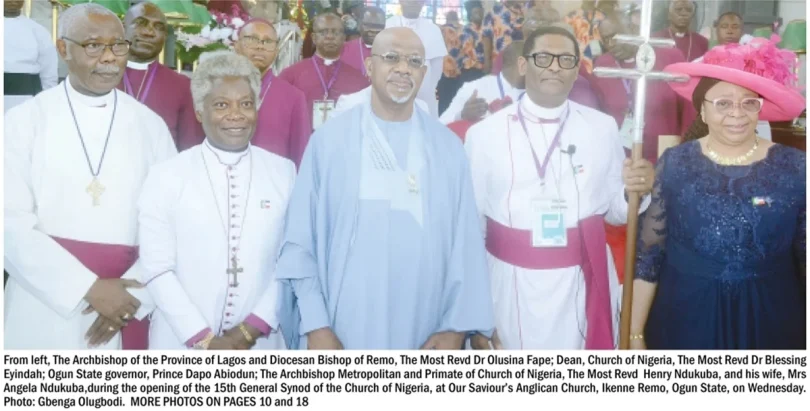

The Archbishop, Metropolitan and Primate of All Nigeria, Church of Nigeria (Anglican Communion), The Most Reverend Henry Ndukuba, has called on the Federal Government to ensure that the recent improvement in Nigeria’s macroeconomic indicators translates into tangible relief for ordinary citizens.
He made the call in his presidential address delivered to the 15th General Synod of the Church, held on Wednesday, at Our Saviour’s Anglican Church, Ikenne-Remo, hosted by the Diocese of Remo, Province of Lagos.
Ndukuba described the General Synod as the highest legislative and decision-making body of the Church of Nigeria.
The theme of the Synod is “The priesthood of all believers: Equipping God’s people for the work of ministry,” taken from 1 Peter 2:4-5, 9-10.
The primate, while assessing the nation’s economy, acknowledged what he described as encouraging developments in some major macroeconomic indicators, however, stressed that the ultimate test of the economic reforms remained their impact on households.
He said: “The core question is no longer whether the country’s macroeconomic numbers are improving, but whether the improvement is reaching ordinary households.”
He noted that though the inflation is showing signs of moderation after rising during the first half of this year, it remains high to provide meaningful relief from the cost-of-living crisis.
“The Federal Government maintains that Nigeria’s $1 trillion economy target is on track. However, it is difficult to share the enthusiasm, as power supply is still a major bottleneck. Without reliable electricity, it is difficult to see how Nigeria’s $1trillion economy by 2030 target can be realised,” he added.
Ndukuba observed that the persistent rise in the prices of essential goods and services continued to erode the purchasing power of workers, pensioners and families, stressing that economic recovery must ultimately be measured by its impact on the lives of citizens.
Speaking on the country’s rising public debt, Ndukuba expressed concern, revealing that the nation’s total public debt stock had risen to N159.28 trillion as of the end of March, while domestic debt servicing costs had also increased significantly.
This development, according to him, in which more than half of government revenue was committed to servicing creditors, would constrain capital expenditure and weaken the country’s capacity to finance infrastructure and other productive investments.
Ndukuba, however, made a distinction between borrowing for productive investment and borrowing for consumption.
“Prosperous nations grow by borrowing to invest in assets that expand their revenue base. For Nigeria, the key issue is the purpose of borrowing. Borrowing to fund consumption deepens debt burdens when what we borrow is stolen by individuals.
“And since what is stolen is not invested in productive ventures, we impoverish our citizens. Borrowing to fund productive investment can spur growth. Fiscal discipline and timely capital budget releases remain essential,” he said.
The Anglican leader described the reported increase in crude oil production as a positive development capable of strengthening Nigeria’s external reserves and supporting exchange-rate stability.
He, nevertheless, warned that oil theft and pipeline vandalism must not be allowed to undermine the gains being recorded in the petroleum sector.
Also, Ogun State governor, Prince Dapo Abiodun, in his address, charged the Church to promote peace, responsible citizenship and peaceful participation ahead of the 2027 general election.
The governor urged the Church to encourage its members to perform their civic responsibilities conscientiously, while rejecting provocation, misinformation, electoral malpractice and violence.
While noting that political differences should not be allowed to destroy the bonds that unite Nigerians, he stressed that elections should be contests of ideas, visions and programmes, rather than occasions for violence.
He charged the Church to provide guidance and opportunities for young people, warning against their involvement in violence, crime, substance abuse and fraud.
He commended the Anglican Diocese of Remo, led by the Bishop of Remo and Archbishop of the Ecclesiastical Province of Lagos, Most Reverend Dr Michael Olusina Fape, as well as the clergy, laity, planning committees and others for their efforts in hosting the Synod.
On his part, Bishop Fape, in his welcome address, noted that the hosting of the Synod, which witnessed the consecration of four new bishops, was a celebration of the faithfulness of God in the Diocese.
He informed that the Diocese, in its 42 years of existence, is hosting programmes of the Church of Nigeria, apart from the Annual Conference of the Anglican Youth Fellowship and National Bible Conference hosted in 2009.
He appreciated God for bringing the Diocese together under one umbrella, having overcome the disunity that pitted different parts of the Diocese against each other from 1993 till 2003.
Those in attendance were the Chairman of the African Newspapers of Nigeria Plc, Ambassador Olatokunbo Awolowo Dosumu; the Chief Imam of Ikenne, Sheikh Lawal, Chief Adewale Ayuba and other eminent Nigerians.