
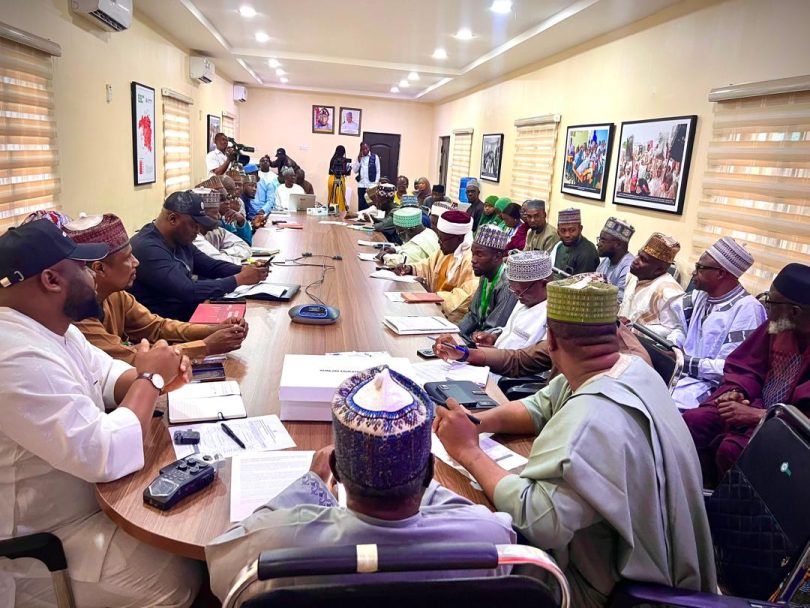
Education stakeholders have hailed Kaduna State’s Reaching Out-of-School Children (ROOSC) initiative as a blueprint for tackling Nigeria’s Almajiri crisis, urging other states to adopt the model.
The endorsement came during Monday’s National Education Sector Renewal Initiative advocacy forum in Kaduna, which brought together government officials, traditional rulers, Islamic scholars, Tsangaya school owners, civil society organisations, and development partners.
Federal Government’s Five-Pillar Reform
Dr Balarabe Shehu Kakale, Special Adviser to the Minister of Education on Almajiri and Out-of-School Children, commended Kaduna’s intervention while outlining federal reforms anchored on five pillars: foundational literacy, numeracy, vocational training, digital education, and civic education.
“Kaduna is a model that can serve as a lesson for scaling up interventions nationwide,” Kakale stated, adding that states should domesticate the National Commission for Almajiri and Out-of-School Children Education Act to reflect their unique challenges.
The Federal Government is strengthening the Nigerian Education Data Infrastructure to enable accurate tracking of children from enrolment through academic progression. “We will no longer depend on third-party estimates. Reliable and verifiable data remains critical,” Kakale emphasised.
100,000 Children Target
Mr Ezra Angai, Kaduna ROOSC Project Coordinator, disclosed that the state aims to reintegrate 100,000 out-of-school children through formal education and alternative learning programmes.
The state has identified 187,912 out-of-school children across 23 local government areas, with over 25,000 already re-enrolled.
“Kaduna has made significant progress, but the challenge is enormous. Our objective is not simply to enrol children but to ensure they remain in school, learn, and acquire skills,” Angai explained.
The project has established Accelerated Basic Education Centres and signed memoranda of understanding with 25 Tsangaya schools serving 6,326 learners, with plans to engage 50 additional schools. Infrastructure improvements will benefit six Tsangaya schools initially, with 27 more in the second phase.
More than 40,000 teaching materials and uniforms have been distributed, alongside psychosocial support. Over 2,000 children with disabilities across nine local government areas have received assistive devices.
“Our approach ensures no child is left behind because of poverty, disability, location, or family circumstances,” Angai added, acknowledging support from the Islamic Development Bank, Kuwait Fund, Global Partnership for Education, Education Above All, Save the Children, and UNICEF.
National Strategic Plan
Representing the Executive Secretary of the National Commission for Almajiri and Out-of-School Children Education, Malam Halliru Musa announced a 10-year strategic plan (2025-2035) and 119 learning centres nationwide, with over 700,000 children mapped for targeted interventions.
Poverty: The Root Cause
Kaduna’s Commissioner for Education, Prof Abubakar Sani Sambo, identified poverty as a primary driver of school dropout rates, particularly in rural and peri-urban communities. “Addressing out-of-school children requires more than building classrooms. It requires a comprehensive approach addressing economic and social conditions affecting families,” he stated.
Call for Sustained Collaboration
Participants called for enhanced collaboration among all stakeholders, improved data collection and sharing, increased education infrastructure investment, community mobilisation, and stronger monitoring mechanisms to ensure retention.
Stakeholders pledged support for integrating Almajiri education into broader opportunities while preserving Tsangaya learning’s cultural and religious contexts, agreeing that sustained political commitment, adequate funding, and coordinated interventions addressing both educational and socio-economic factors are essential to resolving the crisis.