
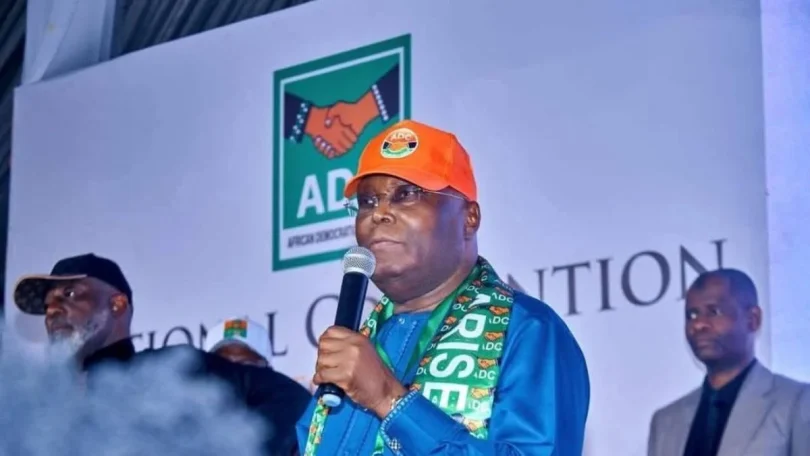
The presidential candidate of the African Democratic Congress, Atiku Abubakar, has pledged to make the rehabilitation and maintenance of Nigeria’s major economic road corridors a national priority if elected in the 2027 presidential election.
Atiku made the commitment in a response to a message from one Hassan Yakubu, who urged him to make the state of Nigeria’s deteriorating roads a major issue in his campaign.
Yakubu, drawing from his experience transporting goods across the country, listed several major routes, including Numan-Jalingo, Dukku-Darazo, Dikko-Minna, Pambegua-Zaria, Akwanga-Jos, Abuja-Lokoja, Bida-Lapai, Kontagora-Makera, East-West Road, Onitsha-Owerri, Abeokuta-Ibadan, Benin-Ore and Benin-Auchi.
He argued that the roads serve as critical links between farms, markets, factories and consumers, warning that their poor condition was increasing transport costs and contributing to higher prices of goods.
Responding, Atiku said he understood the impact of deteriorating infrastructure, noting that he had personally travelled on some of the affected roads and was also a farmer.
“I am a farmer myself, so this is personal to me too. I also developed an interest in mass transportation early in life, and over the decades I have watched our transport infrastructure deteriorate significantly,” he said.
According to him, the consequences of bad roads extend beyond motorists and transport operators, as the additional costs eventually affect consumers.
“The driver pays. The trader pays. The farmer pays. But ultimately, the ordinary Nigerian buying food in the market pays,” Atiku said.
He described transport infrastructure as a critical component of economic activity, arguing that its condition determines how quickly agricultural produce reaches markets, the profitability of businesses and the cost of moving people and goods.
Atiku also said poor roads could have security implications, as stranded or slow-moving vehicles on isolated routes could leave travellers more vulnerable to criminal attacks.
He pledged that, if elected, his administration would identify roads carrying significant volumes of agricultural produce, manufactured goods, raw materials and passengers and prioritise their rehabilitation.
“Let me state my commitment clearly: if elected President, the rehabilitation and maintenance of Nigeria’s critical economic corridors will be treated as a national economic priority, not as an afterthought,” he said.
The former vice president also criticised what he described as the continued abandonment of existing infrastructure while governments announce new and expensive projects.
He said his proposed approach would involve building new infrastructure where necessary, urgently rehabilitating deteriorating facilities and maintaining existing assets.
“Infrastructure under my leadership will not be about monuments to government. It will be about making life easier for Nigerians,” Atiku said.
He added that every public infrastructure expenditure should be assessed by its impact on production, transportation, earnings and the welfare of citizens.
“Every naira we spend must answer a simple question: does this investment help Nigerians produce more, move more easily, earn more and live better?” he said.
Atiku further pledged to prioritise infrastructure that reconnects farms with markets, factories with consumers and communities with economic opportunities.
The ADC candidate also endorsed Yakubu’s appeal for his campaign to focus on national issues rather than ethnic or regional divisions.
“I do not want a Nigeria reduced to Fulani versus Yoruba, North versus South, Muslim versus Christian, or one tribe against another,” he said.
Atiku argued that economic hardship affects Nigerians regardless of their ethnic or regional backgrounds, adding that the country’s challenges require national solutions.
“Our problems are Nigerian problems. Our solutions must be Nigerian solutions,” he said.