
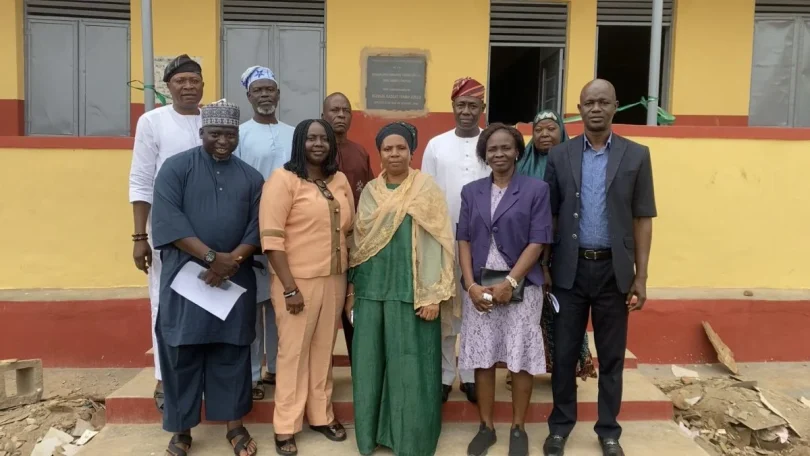
The Ibadan Descendants Union (IDU), New Jersey Chapter, has renovated a block of three classrooms at Islamic Mission Primary School, Moniya, Ibadan, Oyo State, as part of its contribution to the development of education in the state.
The renovated classrooms were commissioned on Monday, August 31, 2026, in the presence of government officials, representatives of the IDU, school management, community leaders, teachers, pupils and other stakeholders.
Speaking at the event, the representative of the Oyo State Universal Basic Education Board (SUBEB) Chairman, Dr Nureni Adeniran, and Executive Secretary of the board, Dr (Mrs) Kemi Adeosun, conveyed the appreciation of the state government to the IDU New Jersey Chapter for the intervention.
He said the project represented more than the renovation of a school building, describing it as an investment in the future of children and an example of how government and communities could work together to improve education.
According to him, the condition of the building before the intervention was not conducive enough for effective teaching and learning, adding that the transformation at the school demonstrated what genuine partnership could achieve.
He said, “A conducive learning environment is not a luxury. It is the very foundation upon which literacy, numeracy, confidence and a child’s sense of dignity are built.
“By providing this facility, the Ibadan Descendants Union has done more than renovate classrooms. It has opened doors of opportunity that will shape lives for generations to come.”
The government representative, who also appreciated members of the community, said the intervention aligned with the administration of Governor Seyi Makinde’s commitment to providing safe and conducive learning environments for children across Oyo State.
He assured the donors that the facility would be properly maintained and put to productive use for the benefit of present and future pupils.
Also speaking, Comrade Adewale Adesina, Education Secretary, Akinyele Local Government, expressed appreciation to the IDU New Jersey Chapter for remembering its roots and investing in the community.
Adesina acknowledged the rising cost of building materials and construction, saying the government appreciated the resources committed to the project.
He said, “We are truly happy and grateful for what you have done for our people. We know the cost of building materials and construction work these days, and we deeply appreciate the resources you have committed to providing this facility.
“I want to give you my assurance that we will take proper care of this building. We will ensure that it is maintained and preserved for the benefit of our pupils.”
The representative of the IDU and chairperson of the occasion, Alhaja Saidat Iyabo Azeez, described the project as an eye-opener and a challenge to other diaspora chapters to emulate the initiative.
Azeez, who said she belongs to the Baltimore Chapter, noted that although she was not a member of the New Jersey Chapter, she was inspired by its intervention.
She said the initiative demonstrated another meaningful way of giving back to the society, particularly through investment in the education and future of children.
“We are not affiliated to any political party or person. Whatever we do is not for politics; we are merely giving back to the community and society,” she said.
Azeez also commended Dr Ibrahim Bello and Alhaji Ademola Yusuf for their commitment to ensuring the project became a reality.
She said the initiative would encourage the Baltimore Chapter and other diaspora groups to consider similar interventions in schools and communities in Ibadan.
“The New Jersey Chapter has opened the way and shown us what is possible. We will therefore look at how we can emulate this initiative and contribute our own quota to the development of our schools and communities,” she said.
Earlier, Alhaji Ademola Yusuf, one of the representatives of the Union in Nigeria, said the classroom renovation was part of a wider intervention programme by the organisation.
Yusuf said the Union had previously supported communities through road grading and interventions in the health sector, including the provision of medicines and first-aid materials to primary healthcare centres.
He said three schools were selected for the current phase of the intervention, adding that the first project had been completed at Aladebomi, while the Moniya project was the second.
According to him, the remaining projects would also be executed in due course.
He said the motivation behind the interventions was to remember their roots and give back to society, stressing that the projects were not politically motivated.
Yusuf, however, urged the school management and community to develop a strong maintenance culture.
“This facility should be treated as if it were our own personal property. We must protect it, maintain it and ensure that it remains in good condition,” he said.
He warned that allowing the facility to deteriorate could discourage the donors from undertaking further interventions, while maintaining it would demonstrate appreciation for their generosity.
The Head Teacher of Islamic Mission Primary School 1, Mr Abdulrasheed Agbaje, expressed appreciation to the IDU New Jersey Chapter for providing the school with a safer and more conducive learning environment.
Agbaje described the intervention as an investment in human capital development and the educational future of the pupils.
He assured the donors that the facility would be properly maintained and used for the purpose for which it was provided.
Also, Mr Ibrahim Bello, who represented the Union, joined other speakers in commending the donors and stakeholders for making the project possible.
On his part, the community representative, Mr Akintunde Tajudeen, appreciated the IDU for undertaking the project in the community.
Tajudeen promised that the community would protect the renovated classrooms and ensure that they remained in good condition, assuring the donors that they would not regret investing in the school.
The commissioning attracted members of the IDU, government representatives, education officials, school management, teachers, pupils, community leaders and other stakeholders.