
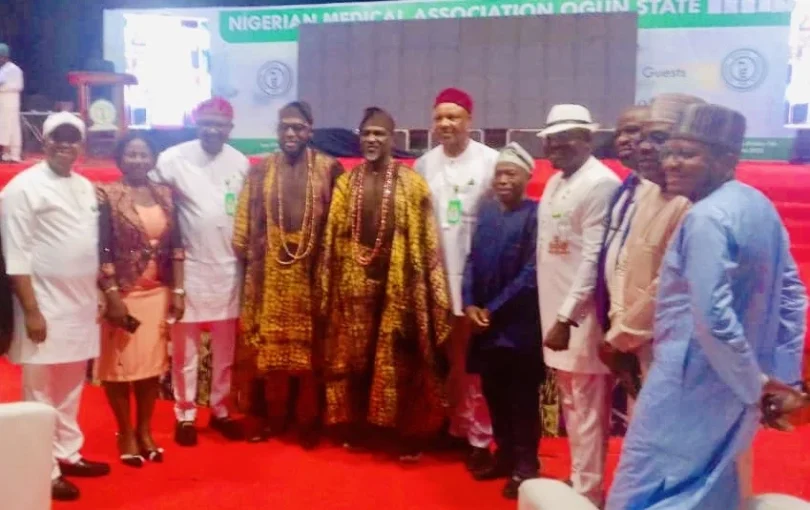
Stakeholders in the health sector on Wednesday urged governments at all levels to prioritize the sector and explore the abundant opportunities inherent in public private partnerships to revolutionize and provide qualitative healthcare services for Nigerians.
They made the call during the National Executive Council meeting of the Nigerian Medical Association (NMA) themed “Beyond Crossroads: Unlocking Health System Potential through Partnerships” and sub themed “Caring for the Caregivers: Doctors Welfare and Mental Resilience in a Broken System,” held at the June 12 Cultural Centre, Kuto, Abeokuta.
The health stakeholders also asked the government to increase its budget allocation to the sector and deepen health insurance coverage to 50 percent, lamenting that only about 4 percent of the country’s total population is currently covered by the health insurance policy.
Speaking at the event, former Commissioner for Health in Ogun State, Dr Babatunde Ipaye, opined that when funding is increased and doctors’ welfare is not left in dire conditions, relative peace would be achieved such that medical doctors will not embark on frequent industrial action.
He said, “We need to open up the health sector’s space and look for opportunities and potential around us, particularly in financing opportunities for health where private capital and donor capital can come in, in a very transparent manner, and improve system development.
“The Nigerian health sector is a baby crying for help. We are not where we are supposed to be, but there is some shift in some direction. In reality, countries that are spending less than us have better scores. It is because we are not working together.
“If we allow transparency within the health sector’s space and have physician led governance, systems and processes that will allow outreaches, collaboration, cooperation and multiple hospitals, they will bring in a lot of resources into the Ogun space that can help us take services to scale.”
Dr Ipaye, speaking about the remuneration of medical doctors in the country, described it as “unacceptable,” saying it may begin to discourage the younger generation from embracing the rigours of medical training.
“The pay for doctors in Nigeria is not enough. Sometimes when I listen to how much my colleagues are paid, I wonder who will even want to study medicine in the first place. There is no justification for putting in that level of input or sacrificing so much of your social life and family life to take care of the health of others, only to earn peanuts.”
Ipaye argued that to correct the anomaly, the government should develop a payment mechanism that is able to pay people according to their effort.
Also, Prof Bala Audu, the National President of the NMA, stated that the theme was inspired by the potential of Nigerian physicians and the country’s healthcare delivery system, which has led some nations to recruit medical doctors from Nigeria.
He encouraged governments at the federal and state levels to treat doctors with more respect and admiration for the job they perform and to improve their welfare so they can contribute more to the country.
According to him, Nigeria has the potential to resurrect medical tourism and serve as a global centre for healthcare professional training; hence the need to explore public and private potential in order to advance the country’s healthcare system.
In his welcome address, the Ogun State NMA Chairman, Dr Luqman Ogunjimi, said this year’s NEC theme is timely and relevant, insisting that all hands must be on deck and committed to supporting and improving productivity in the health sector.
Ogunjimi commended Governor Dapo Abiodun for his current investments in the health sector and urged him to do more to enhance the state’s healthcare system.