
By Sabastine Abu
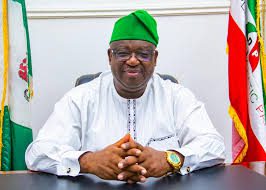
In a seismic shift that has dramatically redrawn Nigeria’s political landscape, Plateau State Governor Caleb Mutfwang has formally abandoned the Peoples Democratic Party (PDP) to join the ruling All Progressives Congress (APC). This strategic decampment after months of speculatiins, confirmed in a ceremony at the Government House in Jos, places the entire North-Central geopolitical zone under APC control and signals a profound realignment ahead of the 2027 general elections.
Governor Mutfwang framed his move as a “divine assignment” for unity, telling supporters he prayed for the moment to reconcile with political adversaries. “I prayed that one day, my predecessor, Simon Lalong, would fall into my hands so I could love him,” he declared, sharing a stage with former rivals in a carefully choreographed display of newfound political brotherhood.
While the governor’s rhetoric emphasizes harmony, political analysts and sources close to the administration point to a multi-layered strategy driving this high-stakes defection.
The Core Strategic Intentions is to avoid pitfalls of the past to recontest under a fragmented conflict ridden PDP with counter court judgements. It would be recalled that similar situation which occurred in the events leading Mutfwang’s election in 2023, threatened his position as governor during the post-election litigations which sadly led to the sacking of all PDP elected Legislators at the State and National Assemblies. Mutfwang himself as governor, survived by the whiskers with the ultimate validation of his victory by the Supreme Court, but, unfortunately not with the PDP legislators whose fate were terminated at the appellate court.
This precarious beginning left his administration vulnerable, constantly operating under the shadow of legal and political challenges from a well-entrenched APC opposition in the state.
Furthermore, navigating Plateau’s complex ethno-religious tensions—often weaponized by political elites across party lines—required a delicate balance. Analysts suggest that by joining the dominant national party, Mutfwang may be seeking to transcend these local fissures by aligning with a broader, federal power structure, hoping to reposition himself as a unifying figure above the fray of local partisan conflict.
Pundits have also justified the governor’s shift as a move for future survival to consolidate on the developmental strides being experienced in the state.
Close allies of Mutfwang have listed some of the expected gains of his shift to the national ruling APC to include;
. Securing Federal Alignment and Resources: Perhaps the most immediate driver is the need to align with the federal government under President Bola Tinubu. As an opposition governor, Mutfwang faced challenges in securing federal projects and interventions for Plateau State. By joining the APC, he seeks to unlock federal coffers and ensure Plateau is not sidelined in national development agendas, directly tying his administration’s performance to access to central government resources.
The move is widely seen as a pre-emptive consolidation of power. With the next election cycle looming, Mutfwang has positioned himself as a key asset for the ruling party, publicly pledging to deliver “one million votes” for President Tinubu.
This gambit secures his political future by embedding him within the national ruling structure well before the campaign season begins, transforming him from an opposition figure into a ruling-party insider.
By moving to the APC, Mutfwang effectively decapitates the formal opposition within Plateau. His defection, followed by key aides and local government chairmen, fragments the PDP’s structure in the state. This absorption of political actors into one big tent aims to create a monolithic political landscape, ostensibly to foster stability but, also to centralize power under his leadership.
The defection has elicited starkly contrasting reactions which reveals the deep fractures in Nigerian politics.
The APC leadership has rolled out the red carpet. National and state party chairmen have hailed the move as a “homecoming” and a masterstroke that strengthens the party’s national dominance. A grand reception is planned to cement his integration into the party fold.
Conversely, the PDP in Plateau has reacted with fury. The state chapter has labeled Mutfwang a “betrayer” of the public mandate, arguing that the votes cast for the PDP have been illegitimately transferred to the APC. They have called for his resignation, stating the moral authority to govern under his original platform has been shattered. Public intellectuals and civil society groups have echoed this sentiment, warning that such cross-carpeting undermines democratic accountability and reduces political parties to mere vehicles for ambition.
It is however important to X-ray the governor’s defection within a realistic context to appreciate his move.
While Mutfwang’s strategic calculus offers potential rewards, it is also fraught with significant risk.
The potential rewards would obviously be enhanced his governing capacity, smoother relations with the federal government to attract tangible projects and improved security cooperation for Plateau. It will also potentially pave a clearer path for the governor’s political future, both within and beyond his gubernatorial term and a stronger platform to control narrative which allows him to frame himself as a bridge-builder who sacrificed partisan pride for state unity and development which Plateau State desperately need to grow from years of sharp political divisions.
Meanwhile, the substantial risks by this move as perceived by a few conservative groups made up of some of the governor’s original supporters in PDP, as an act of sheer opportunism, potentially alienating his core electoral base.
There is also internal APC rivalry which his defection has brought about. For instance, by his entry into the APC, he automatically assumes the leader of Party in the State which may not go down too well by some defiant within. With this in view, governor Mutfwang must now navigate internal APC dynamics, facingy these resentments from longstanding party members who may consider him as a privileged newcomer.
One thing that also makes governor Mutfwang’s defection grand, is that it gives added legitimacy to the National Chairman of APC, Professor Nentawe Goshwe Yiwatda whose indigenous home State in a Party he leads, has finally been realigned.
To continue to enjoy the overwhelming support of Plateau people, the governor must now onward do everything within his powers to up the game of delivering more tangible dividends of democracy and of his administration to the people of Plateau State to justify this defection and also, to win over, remnants of his conservative supporters still in the PDP.
To note more clearly, Governor Caleb Mutfwang’s defection to the APC is more than a routine party switch; it is a strategic pivot aimed at securing survival, relevance, and influence. By framing it as a mission for unity, he seeks the moral high ground. However, the ultimate judgment will not be rendered in the ceremony halls of Rayfield but, in the towns and villages of Plateau State who earn for development.
The citizens will measure the success of this political calculus not by the number of party flags exchanged, but by the palpable improvement in their daily lives—increased security, economic opportunity, and social cohesion. As the dust settles on this political move, Governor Mutfwang has bet his tenure on the belief that alignment with central power is the most direct route to delivering these results. Only the coming years will tell if this strategic intention was a vision of foresight or a fatal miscalculation. However, one thing is certain, majority of Plateau people still believe in governor Caleb Mutfwang and they are willing to go all the way with him.