
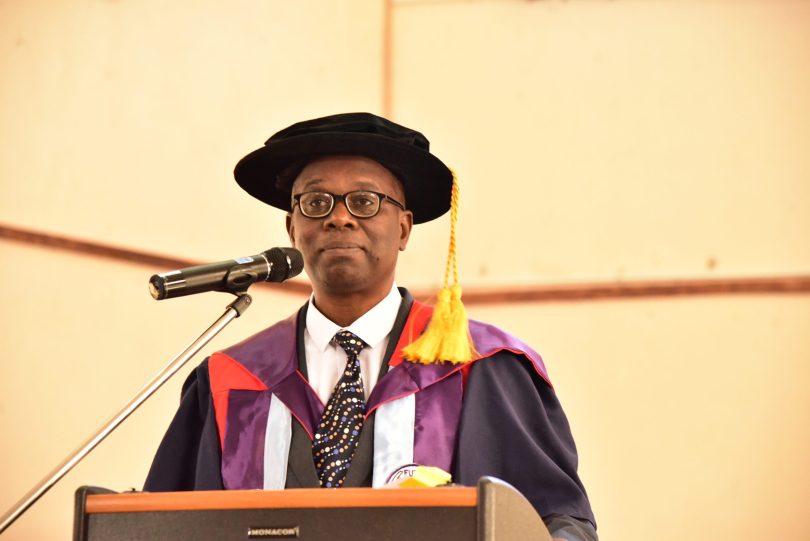
With enabling environment and investment in research, Nigeria can produce insulin to treat diabetes and antivenom for snake and scorpion bites in commercial quantities. A Professor of Enzymology and Biophysical Chemistry at the Federal University of Technology, Akure, FUTA, Ayodele Kolawole stated while delivering the 190th inaugural lecture of the institution on Tuesday, 13th January, 2026.
Kolawole who titled his lecture, “Exquisiteness of Enzymes: Its Economic in Its Entrepreneurial Ecosystem,” said “Nigeria has the potential to produce its own insulin for diabetic patients and its own antivenom for snake and scorpion bites.” He added that “enzymes of significance are abundant in our surroundings, and it is imperative that we collaborate to isolate and utilize them effectively. By pooling our resources and leveraging shared facilities, we can purify these enzymes for industrial and laboratory applications.” Stating the significance role played by enzymes in human activities, the don said “enzymes are superbly crafted biological catalysts that, in small amounts, drive all biochemical reactions. They increase the reaction rate by many orders of magnitude by lowering the activation energy while ensuring high fidelity in donor-acceptor transactions.”
Speaking on how to encourage local production, Kolawole advised that the government needs to take a bold step to ban the importation of enzymes for our bio-processing and encourage local production. He also advised that those who drive the country’s industrial development and other critical stakeholders should see enzymes as a critical part of the country’s industrial development and all structures should be put in place to encourage local production for industrial and laboratory use since the potential for such production is also locally available. He said “enzymes are powerful tools, and their proper use can yield significant benefits. Enzymes are connected to our industrial development. By prioritizing local production and reducing reliance on imports, Nigeria can unlock the full potential of her indigenous cereals.”
Kolawole decried the almost total dependence on importation of the catalysts saying it’s a huge drain on the country’s foreign exchange. According to him, “Take a look at our food and health industries, all the enzymes needed in both sectors, the amylases and the proteases for the breakdown of carbohydrates and proteins, are still been imported. The government needs to take a bold step to ban the importation of enzymes for our bio-processing.”
The lecturer also pilloried the ivory tower for not doing enough in this regard. “Unfortunately, our universities, in their bid to survive, have begun to mirror society, rather than leading the way. This is a concerning trend where the gown is competing with the town in business and entrepreneurial ventures. Our Universities should focus on driving innovation and economic empowerment, rather than duplicating existing efforts. our universities should go beyond pursuing agricultural ventures,” Kolawole said.
Professor Kolawole called on government to increase fund allocation to biochemical research so as to stimulate high quality, cutting edge research. He emphasized the importance of constant electricity supply to enhance research work. “Bioscience research requires continuous electricity to power some equipment and keep research moving. Bioscience research suffered a severe setback in the last two years when electricity tariffs became exorbitant and Nigerian Universities could not cope. Power rationing is inimical for scientific breakthroughs. Electricity supply to universities and research institutes should be heavily subsidized, if not made free.”
The don also advocated for the training of enzymologists in Nigeria. He said “there are few enzymologists in Nigeria. Some trained biochemists were scared to venture into this research. The scientific world is gradually expanding and breaking new frontiers and we are gradually being left behind. Nigerian scientists are not lacking in intellectual capability, but rather, their potential and creativity is hindered by inadequate manpower, outdated equipment and insufficient facilities. There is need to create more research fund for basic enzyme research. by now, Nigeria should have had an Institute of Enzymology or Protein Research Institute with a mandate to rejig and motivate enzyme and protein research.”
At the continental level, Professor Kolawole said “enzymology offers Africa diverse opportunities for decentralized economic activities, participatory research, and community-level control. Its science-intensive nature would reduce capital-related barriers, making it accessible for development. we must mobilize our expertise to transform our nation and continent by harnessing enzymology to drive progress.”
Introducing the lecturer, the Vice Chancellor, Professor Adenike Oladiji who Chaired the event described Professor Kolawole as a renowned scholar who has won several research grants for the university. Professor Oladiji who was represented by the Deputy Vice Chancellor, Development, Professor Sunday Oluyamo said the lecturer has added value to his field of study having churned out products at the under and post graduate levels who are doing very well around the world in addition to serving in many university’s committee as Chairman or member.