
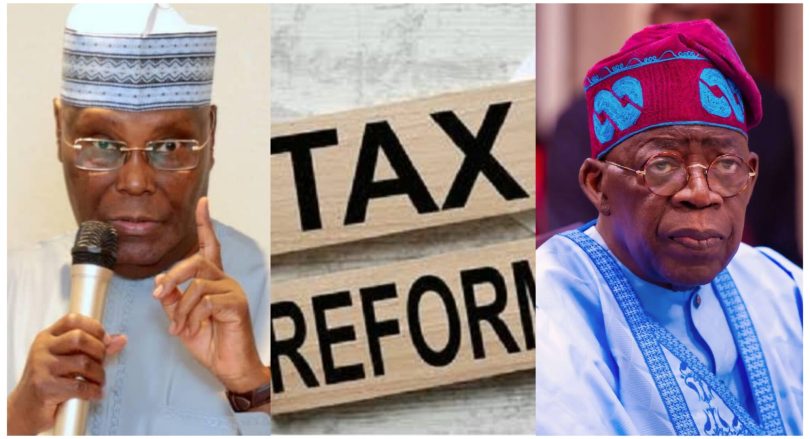
Former Vice President Atiku Abubakar has accused the Bola Tinubu administration of committing what he described as an act of treason against Nigerians through alleged illegal alterations to the recently passed tax reform laws.
In a strongly worded statement, Atiku said changes were made to the tax legislation after it was passed by the National Assembly, calling the action unconstitutional and a direct threat to Nigeria’s democratic system.
Allegation of Constitutional Breach
Atiku said the alleged alterations violated Sections 4 and 58 of the 1999 Constitution, which clearly define the law-making powers of the legislature.
He described the action as a “brazen assault on legislative supremacy” and warned that it undermines the foundation of constitutional democracy.
According to him, the changes show a government more focused on extracting revenue from struggling citizens than empowering them to prosper.
New Enforcement Powers Raised Concern
The former vice president alleged that new coercive powers were inserted into the tax laws without legislative approval.
These include arrest powers for tax authorities, seizure of property and garnishment without court orders, and enforcement sales carried out without judicial oversight.
He said the provisions effectively turn tax officials into quasi-law enforcement agents and strip Nigerians of due process protections deliberately included by lawmakers.
Increased Burden on Citizens and Businesses
Atiku further alleged that the alterations imposed heavier financial obligations on citizens and businesses.
He listed a mandatory 20 per cent security deposit before appealing tax assessments, compound interest on tax debts, and stricter quarterly reporting requirements with lowered thresholds.
Other changes, he said, include forced United States dollar computation for petroleum operations, which he warned would increase compliance costs in an already difficult economy.
Oversight Mechanisms Allegedly Removed
The statement also accused the government of removing accountability safeguards from the law.
Atiku said provisions requiring quarterly and annual reports to the National Assembly were deleted.
He added that strategic planning submission requirements and ministerial supervisory roles were also removed.
According to him, stripping away oversight while expanding executive powers is a hallmark of authoritarian governance.
“Government Against Its People” — Atiku
Atiku argued that the alleged constitutional violation reflects a government hostile to the welfare of its citizens.
He said Nigeria continues to battle high poverty levels, unemployment, and inflation, yet the administration has chosen aggressive taxation over policies that promote productivity.
Rather than investing in infrastructure, education, healthcare, and economic empowerment, he said the government opted for what he called “draconian extraction” from an impoverished population.
Call for Immediate Action
The former vice president called on the executive arm to immediately suspend implementation of the tax law scheduled to take effect on January 1, 2026.
He urged the National Assembly to correct the alleged illegal alterations through proper legislative processes and hold those responsible accountable.
Atiku also asked the judiciary to strike down the unconstitutional provisions and reaffirm the sanctity of the legislative process.
Appeal to Nigerians and Anti-Graft Agency
He called on civil society groups and Nigerians to reject what he described as an assault on democratic principles.
Atiku also urged the Economic and Financial Crimes Commission (EFCC) to investigate and prosecute individuals involved in the alleged illegal alteration of the law.
He warned that allowing laws not passed by the National Assembly to stand would open the door to arbitrary rule.
“The Nigerian people deserve better than a government that circumvents democracy to impose hardship,” Atiku said, while demanding accountability, constitutional compliance, and policies that promote prosperity rather than deepen poverty.