
Nigeria’s largest consumer goods companies are making fewer bets on what Nigerians will buy.
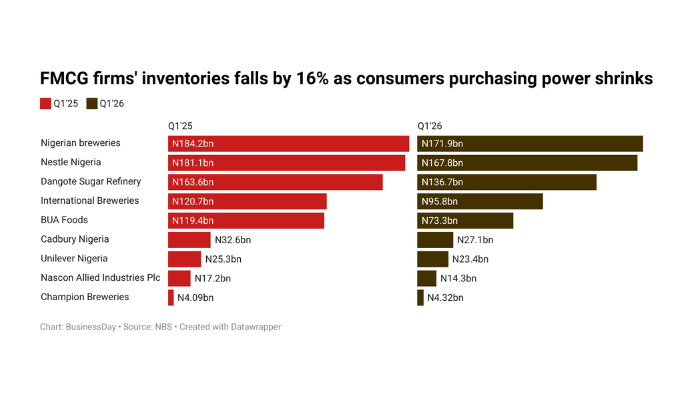
Faced with households still struggling with high cost of living, listed manufacturers’ unsold inventories fall by 16 percent in the first quarter of 2026, signalling that they are producing more cautiously and buying fewer raw materials as consumer demand remains fragile.
BusinessDay’s analysis of nine listed consumer goods and brewing companies shows combined inventories declined to N714.6 billion in Q1 2026 from N848.2 billion a year earlier, while raw material holdings plunged by 33.8 percent, reflecting a cautious approach to manufacturing despite resilient profitability.
The inventory drawdown comes even as aggregate revenue edged higher to N1.65 trillion from N1.64 trillion, while combined profit jumped 32.5 percent to N297.2 billion from N224.4 billion, suggesting companies are becoming more efficient rather than simply producing more.
The trend reflects a sector still navigating Nigeria’s difficult consumer environment, where inflation has eased from 2024 peaks, but purchasing power remains weak, forcing manufacturers to prioritise cash preservation, lean inventories, and faster stock turnover over volume expansion.
Manufacturers shift from growth to efficiency
Inventory is often one of the clearest indicators of corporate expectations. Rising inventories typically signal confidence in future demand, while falling inventories suggest companies expect slower sales or are intentionally avoiding excess stock.
Read also: WORLD IN BRIEF: German shelter shooting kills six, DR Congo bans mass gatherings, Ethiopia seals $1bn debt restructuring deal and other stories
Across the consumer goods sector, manufacturers appear to have chosen the latter.
Raw material inventories among companies that disclosed detailed breakdowns, including Nestlé Nigeria, BUA Foods, Dangote Sugar, Cadbury Nigeria, Unilever Nigeria, and Nascon Allied Industries, fell to N165 billion from N249.2 billion, a reduction of almost N84 billion.
The decline indicates companies are buying fewer production inputs, reflecting cautious procurement strategies as firms seek to minimise financing costs and reduce exposure to volatile commodity prices.
Finished goods inventories, however, remained broadly stable, rising slightly to N104.3 billion from N100.7 billion, suggesting manufacturers are producing closer to actual demand rather than accumulating unsold products.
Overall inventories consequently dropped by more than N133 billion, highlighting a deliberate shift toward leaner operations.
The strategy aligns with broader manufacturing trends.
The Manufacturers Association of Nigeria (MAN) has repeatedly highlighted weak consumer demand as one of the biggest constraints facing factories, despite improving macroeconomic indicators. Manufacturers have increasingly focused on inventory optimisation, working capital management, and cost efficiency as households continue to prioritise essential spending.
BUA Foods, Nestlé lead inventory reduction
Among the companies analysed, BUA Foods recorded one of the sharpest adjustments.
Its total unsold inventory declined by 38.6 percent to N73.3 billion from N119.4 billion, driven largely by a reduction in raw material holdings from N78.5 billion to N34.1 billion.
Yet profits rose 13.7 percent to N142.3 billion, despite revenue declining to N394.6 billion.
The numbers suggest BUA Foods successfully converted inventories into sales while maintaining healthy margins through better operational efficiency and improved cost management.
Dangote Sugar Refinery also significantly reduced inventories, cutting total unsold stock by 16.4 percent to N136.7 billion.
More importantly, the company returned to profitability, posting a N19.1 billion profit after recording a N23.6 billion loss in the corresponding period of 2025.
Nestlé Nigeria, one of the country’s largest food manufacturers, trimmed unsold inventories to N167.8 billion from N181.1 billion, while growing profit nearly 29 percent to N38.9 billion and increasing revenue above N326 billion.
The results suggest Nestlé has become more disciplined in matching production with actual market demand following the foreign exchange-induced disruptions that affected earnings over the past two years.
Consumer demand remains fragile
Although headline inflation has moderated by 15.93 percent in May, compared to 22.97 percent in the same period of 2025 following the National Bureau of Statistics’ rebasing exercise, many households have yet to experience meaningful improvements in purchasing power.
Real wages remain under pressure while elevated borrowing costs continue to constrain consumer spending.