
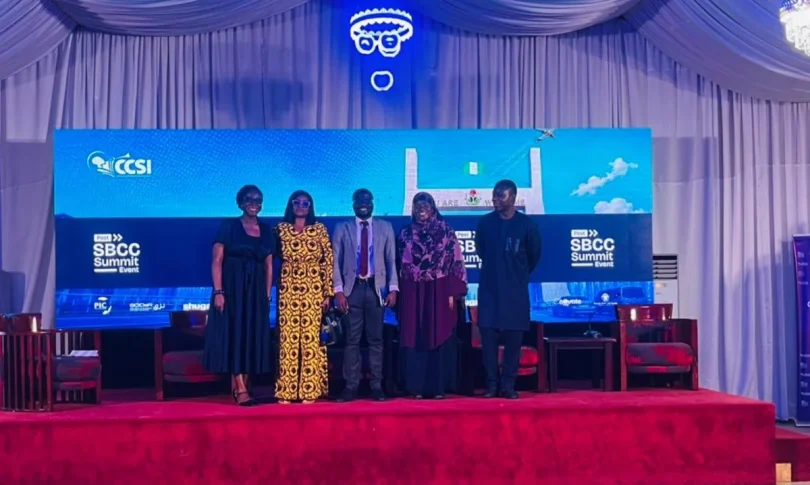
The Federal Government has been urged to strengthen community ownership and build sustainable systems to support effective Social and Behaviour Change Communication (SBCC) interventions across Nigeria.
The call was made in Abuja at a post-SBCC Summit engagement organized by the Centre for Communication and Social Impact (CCSI), where experts called for SBCC to move beyond fragmented, short-term projects towards coordinated, community-led, and sustainable interventions.
The engagement, themed “Collectively Inspiring SBCC in Nigeria,” followed the recently concluded global SBCC Summit in Panama. It provided an opportunity for practitioners to examine lessons from the summit and consider their application to Nigeria’s health, social, and development needs.
Executive Director of CCSI, Babafunke Fagbemi, said stronger coordination among SBCC practitioners was needed to reduce fragmentation and improve the impact of interventions.
She urged stakeholders to move away from working as isolated organizations and recognize their roles within an interconnected system.
ALSO READ: FG urged to prioritise investment in smart diagnostics
“If you don’t want a fragmented system, you have to start from a plan, a plan that sees everybody as members playing part of a system,” Fagbemi said.
Fagbemi also called for global SBCC lessons to be adapted to Nigeria’s local context, saying the country had the expertise and experience needed to develop solutions to its challenges.
“We want to make sure that we are bringing this back home and we’re not just treating SBCC as a platform. It’s integral to who we are as Nigerians,” she said.
She identified mindset change as an important part of behavioural transformation and urged Nigerians to take greater responsibility for addressing social challenges.
“I think first it begins with how we think. So you want to change the way people think. You want to change their mindset,” she said.
On misinformation and disinformation, Fagbemi advocated community-led approaches built around trusted local structures.
“Don’t forget that local solutions solve local problems best. We can’t import solutions from outside the country to come and help us find our problems,” Fagbemi said.
Also speaking, Temidayo Ibitoye of Dinovate said storytelling should be viewed as an intervention that can contribute directly to behavioural change rather than simply a means of packaging messages.
“Story is not simply told. Story can be the intervention,” Ibitoye said.
He identified trust as a key factor in behaviour change, noting that people were more likely to respond when communication reflected their realities and experiences.
“Trust is a currency of behaviour change,” he said.
Ibitoye urged stakeholders to shift SBCC from short-term projects to sustainable systems by sharing knowledge, tools and lessons.
“SBCC in Nigeria needs to move from project to system,” he said, adding, “We are not each other’s competition. We are each other’s foundation.”
Wame Jallow of Shuga Global said collaboration was one of the major lessons from the Panama summit, urging practitioners to work together to strengthen the sector.
She said Shuga Global’s storytelling interventions with young people were designed to build agency and support informed decision-making.
“We started in 2013 in Nigeria and we’ve had five series ever since then and a lot of our intentional work was around building agency for young people to make informed choice,” Jallow said.
Emmanuel Nwala, Associate Director, Research at the Policy Innovation Center (PIC), called for a systems approach to SBCC, particularly amid changes in the global funding landscape.
“People are already moving SBCC to systems. So they are applying systems approach other than delivering SBCC as a component, or to go to deliver SBCC to communities,” Nwala said.
He urged practitioners to make greater use of existing evidence in policy and programme decisions instead of focusing predominantly on generating new research.
“We need now to move away from producing evidence all the time, to using the available evidence to make informed decisions,” he said.
Nwala also called for SBCC interventions to be assessed by behavioural outcomes rather than mainly by audience reach.
“There’s a bridge between how they are reached and how the behaviour itself is being changed and is being measured,” he said.
On technology, he said artificial intelligence and digital SBCC could support more effective interventions but should remain human-centred.
“AI and digital SBCC can never replace human-centred design approaches,” Nwala said, while stressing the need for data protection and culturally appropriate digital solutions.
Roselyn Odeh of the Society for Family Health (SFH) said understanding community beliefs and perceptions should come before the design of SBCC campaigns.
“We have to find the beliefs before we build a campaign. Quantitative data helps us to test, but it does not give us insights. Real insights can only come when we actually speak to people,” Odeh said.
She urged practitioners to consider household and community-level influences when designing interventions.
“If the decision runs through a household, an intervention that is aimed at the girl alone is not adequate,” she said.
Odeh also advocated Human-Centred Design and stronger community ownership, saying communities should be involved as active participants and co-owners of interventions.
“We must engage communities as active participants and co-owners, because they do hold valuable knowledge,” she said.
Halima Buba of SCIDaR similarly urged practitioners to involve communities as partners rather than treating them only as beneficiaries.
“We need to actually see the beneficiaries as people to collaborate with for whatever intervention that we’re actually committing,” Buba said.
She cautioned against relying solely on assumptions based on past experience, noting that community realities change over time.
“To really change behavior, you need to understand where I’m coming from, what matters to me, what are my concerns, what are my issues, from my perspective, from my lens,” she said.
Buba also called for unconventional voices, including young people, market women and transport workers, to be included in SBCC interventions.
Samson Odukogbe of ARFH said Nigeria’s diversity meant that a single SBCC message could not resonate across all communities.
“The challenge for Nigeria’s diversity would be the fact that you cannot use one message to resonate across all,” Odukogbe said.
He urged stakeholders to use existing structures, including religious and community leaders, health professionals, youth groups, social media personalities and content creators, to support behaviour change.
“We need to leverage on this existing structure just so we can make that impact on the change we want to see in our communities,” he said.
Foyeke Oyedokun-Adebago of the Population Council called for SBCC to be institutionalised as a core government function rather than remain dependent on individual programmes and donor funding.
“We need to move beyond programs and start thinking in systems,” she said.
She identified stronger government structures, sustainable financing, professional capacity, and the integration of behavioural and community-level evidence into government planning as key requirements for institutionalising SBCC.
Oyedokun-Adebago said government units responsible for health education and health promotion needed adequate authority, staffing and technical resources to perform their mandates effectively.
She also called for predictable SBCC financing, saying funding should continue beyond individual projects and donor cycles.
According to her, the success of institutionalisation should be measured by whether the people, knowledge and financial systems established through interventions remain functional after projects end.
“Whether we truly institutionalize is whether the people, the learning systems, the financial systems are remaining and sustaining that change that the project has brought,” she said.
The experts agreed that Nigeria already had the human resources, community networks, evidence and creative capacity needed to strengthen SBCC.
They urged the Federal Government to work more closely with communities, civil society organizations, development partners, researchers, media practitioners, educational institutions, and content creators to establish a coordinated and sustainable SBCC ecosystem.
They also stressed the need for Nigeria’s SBCC strategy to combine global knowledge with local realities, build trust, use technology responsibly, and integrate successful interventions into lasting government and community systems rather than allowing them to end with individual projects or funding cycles.