
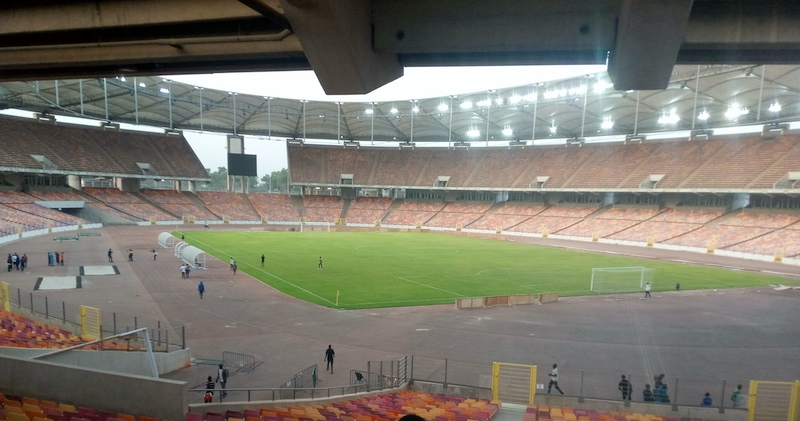
The federal government has revealed plans to roof the Moshood Abiola National Stadium in Abuja, in a move the government has said will turn the stadium into a world-class facility.
Chairman of the National Sports Commission (NSC), Malam Shehu Dikko, made this known during a meeting with representatives of four Federal Government-owned media organisations in Abuja.
TheNewsGuru (TNG) reports the organisations are News Agency of Nigeria (NAN), Nigeria Television Authority (NTA), Voice of Nigeria (VON) and Federal Radio Corporation of Nigeria (FRCN).
Dikko disclosed that the federal government was taking steps to upgrade the Moshood Abiola National Stadium to enhance its suitability for sporting events and other activities.
Dikko identified the ongoing and proposed improvements as part of efforts to reposition the stadium as a world-class facility capable of hosting major sporting competitions and non-sporting events.
He said the commission was working to improve the stadium’s facilities, including its grass playing surface, lighting and other essential infrastructure.
Dikko said the commission was also considering roofing the stadium to improve its appearance, functionality and suitability for different categories of events.
He explained that the proposed improvements were intended to make the facility more attractive to athletes, sports administrators, event promoters and private investors.
According to him, the commission is exploring ways to transform the stadium into a multipurpose sports and entertainment centre that can generate revenue beyond match days.
“We want the stadium to be active, not only when football matches are being played but also for other events and commercial activities.
“The plan is to develop the stadium into a vibrant sports complex with complementary facilities, including hospitality, commercial and conference services,” Dikko said.
He added that the commission was working towards a model that would encourage private-sector investment in the development and management of sports infrastructure.
The chairman said the initiative would help reduce dependence on government funding for facility maintenance while creating opportunities for employment and business growth.
He stressed that sports infrastructure should be treated as a national asset capable of generating economic benefits when properly maintained and commercially managed.
Dikko also highlighted the importance of collaboration with the media in promoting sports development, attracting investment and showcasing the country’s sporting achievements.
He called for stronger partnerships between the commission and government-owned media organisations to improve sports coverage and public awareness of ongoing reforms.
“The commission is committed to developing grassroots sports, expanding opportunities for young athletes and strengthening Nigeria’s capacity to compete internationally.
“A stronger sports economy would create direct and indirect employment opportunities across several sectors, including broadcasting, tourism, hospitality and commerce.
“We will continue to engage relevant stakeholders to ensure that sports facilities across the country were properly developed, maintained and utilised.
“I urge the media organisations to work closely with the commission in communicating its programmes and projects to Nigerians,” he added.
The visit provided an opportunity for discussions on media collaboration and strategies for promoting sports development and investment in Nigeria.
NSC targets N1trn sports infrastructure fund
Meanwhile, Dikko also disclosed that the NSC is working towards mobilising a N1 trillion infrastructure fund to accelerate sports development, rehabilitate facilities and attract private sector investment into the Nigerian sports economy.
He said the initiative formed part of efforts to reposition sports as a viable economic sector through sustainable infrastructure financing, commercial partnerships and improved management of sporting facilities.
“We are exploring innovative funding and investment models to ensure that sports infrastructure generates revenue rather than remaining dependent on government funding,” he said.
According to him, the government is committed to creating an enabling environment for private investors to participate in the development and management of sports facilities.
“We have to sit down and look at how we can work together, because it is not just about the picture of the facilities, but about opening them up, making them work and generating revenue,” he said.
“The commission is pursuing partnerships to transform stadiums into multipurpose facilities capable of hosting sporting competitions, conferences, entertainment programmes and other commercial activities.
“The strategy will help maximise the economic value of public infrastructure while creating employment opportunities and supporting the growth of related industries,” Dikko said.
The NSC chairman noted that stadiums should operate beyond match days, with facilities such as hotels, restaurants, conference centres, advertising platforms and commercial spaces providing additional revenue.
He added that the commission was exploring arrangements with investors and facility managers to complete outstanding projects, and improve the commercial viability of existing sports infrastructure.
Dikko said the initiative was also aimed at developing world-class sporting facilities across the country to support athletes, attract international competitions and strengthen Nigeria’s position in global sports.
He stressed that sustainable sports development required a coordinated approach involving government agencies, private investors, sports federations and other stakeholders.
The chairman also identified grassroots sports development as a key component of the commission’s broader strategy.
According to him, investment in schools and community facilities would help identify and nurture talents for national and international competitions.
He said Nigeria could benefit economically from its vast pool of sporting talents through structured development programmes and opportunities for athletes to compete internationally.
Dikko further emphasised the importance of collaboration with the media in attracting investors, promoting sporting events and communicating the economic opportunities available in the sector.
“The commission is also working towards establishing a dedicated sports television channel to expand coverage of sporting activities, attract sponsorship and create additional commercial opportunities.”
According to him, stronger media partnerships will be critical to increasing the visibility of Nigerian sports and attracting the corporate sector to invest in sporting competitions and infrastructure.
He called for sustained cooperation among the commission, government-owned media organisations and private sector stakeholders to achieve the country’s sports development objectives.