
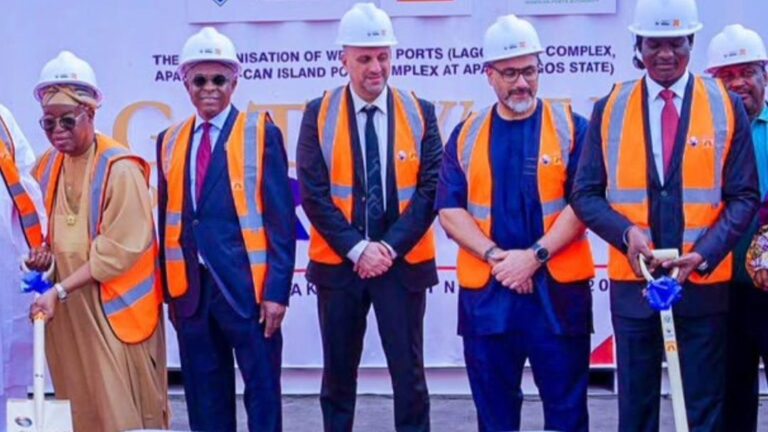
The federal government on Wednesday flagged off the modernisation of the Lagos Port Complex, Apapa and Tin Can Island Port, to reposition Nigeria for national development and as a leading maritime hub in Africa.
Adegboyega Oyetola, the minister of marine and blue economy, led the ceremony at Tin Can Island Port alongside finance minister Taiwo Oyedele and senior government officials in Lagos.
This was noted in a statement on Wednesday. According to the statement, the project costs 746 million pounds, approximately N1.45 trillion and will address decades of infrastructure deficits at both major ports for national development.
Mr Oyetola said the modernisation would reduce logistics costs, attract international shipping lines, stimulate industrial growth, and create at least 20,000 direct and indirect jobs for national economic growth and development.
Furthermore, the minister described the programme as a significant step toward realising President Bola Tinubu’s Renewed Hope Agenda, which prioritises infrastructure development for economic growth and investment.
He noted that Apapa Port, established in 1913, was more than a century old, while Tin Can Island Port was commissioned in 1977 to further national economic growth and development.
“At commissioning, Nigeria’s population stood at approximately 67.2 million annual trade was about 17 billion dollars, and cargo throughput was eight million tonnes.
“Today, Nigeria’s population has grown to approximately 240 million; merchandise trade exceeds one hundred billion dollars annually across all sectors. Cargo throughput has increased to 129.3 million metric tonnes, nearly 16 times its 1977 level nationwide,” Mr Adegboyega stated.
The statement said Mr Oyetola explained that the mismatch between growing economic activities and ageing port infrastructure has made comprehensive modernisation both urgent and unavoidable for national development, economic growth, and investment today.
He warned that the cost of inaction was far greater than the cost of modernisation, adding that Nigeria would not surrender its competitive advantage to neighbouring countries.
It noted that the minister lamented cargo dwell time at Nigerian ports, which ranged between 10 and 18 days, compared with three to five days at leading international ports.
He said these inefficiencies cost the Nigerian economy as much as four billion dollars annually through congestion, demurrage, storage charges, and higher logistics costs for traders.
According to the statement, Mr Oyetola said the project will rehabilitate quay walls and berths, dredge navigation channels, and improve access facilities, cargo-handling equipment, and operational systems for efficient, digitally enabled operations.
The statement noted that the minister approved an Inter-Ministerial Committee comprising the Marine Ministry, Nigerian Ports Authority, and the Regulatory Agency to develop a port business continuity and cargo flow management plan.
The statement also noted that the managing director of the Nigerian Ports Authority (NPA), Abubakar Dantsoho, described the groundbreaking as a landmark moment in NPA’s history.
He reaffirmed NPA’s commitment to delivering the project according to approved designs, standards, and timelines in Lagos.
He assured stakeholders that NPA would maintain robust technical supervision, quality assurance, and effective coordination throughout construction, with particular attention to safety, environmental standards, and continuity of operations.
(NAN)