
Secrets Reporters
The National Centre for Energy Efficiency and Conservation (NCEEC), a federal research institution hosted by the University of Lagos (UNILAG), has come under scrutiny over procurement breaches, an unexplained multimillion-naira overpayment, an overseas trip without evidence of the required clearance and failure to properly account for a government vehicle, information exclusively obtained by SecretsReporters has revealed.
The findings cover transactions undertaken between 2018 and 2020 and raise questions about procurement procedures, financial controls and the management of public resources at the centre, which is supervised by the Energy Commission of Nigeria (ECN).
According to information obtained by SecretsReporters, four separate issues involving approximately ₦29.89 million were flagged in the report covering non-compliance and internal control weaknesses in federal Ministries, Departments and Agencies.
The records show that the centre could not provide satisfactory explanations or supporting documentation in response to the queries raised over the transactions. Recommendations were subsequently made for the recovery of affected sums and the application of sanctions where the expenditures could not be justified.
One of the most striking findings involved the purchase of a five-seater pickup truck valued at ₦10,371,625.
The transaction, according to the information obtained by SecretsReporters, lacked key procurement documents required under Section 24(1) of the Public Procurement Act 2007 and the applicable Financial Regulations.
Among the documents reportedly unavailable were evidence of needs assessment, advertisement, bidding records and relevant Tender Board minutes.
More troubling was the timing of the transaction. The vehicle was delivered to the centre on February 4, 2018, while the contract was formally awarded on March 19, 2018, meaning the vehicle had allegedly been delivered 43 days before the contract was formally awarded.
The sequence raised serious questions about compliance with established procurement procedures, which ordinarily require the procurement process and contract award to precede execution and payment.
The transaction was consequently flagged over the risk of loss of government funds, waste of public resources and possible diversion.
The recommendation contained in the findings was for the centre to justify the expenditure and recover the ₦10,371,625 for remittance to the Treasury if the expenditure could not be justified, with possible sanctions under the applicable Financial Regulations.
The same ₦10.37 million vehicle transaction also generated another concern. SecretsReporters learnt that the pickup truck was not entered in the centre’s store ledger as required by the Financial Regulations.
The absence of the vehicle from the store ledger raised concerns over the proper accounting and custody of government property.
The recommendation was again for the centre to provide justification and ensure recovery of the value where appropriate, with sanctions recommended in the absence of satisfactory explanation.
Another major issue involved a construction contract for an office building at the University of Lagos. The contract was valued at ₦196,426,962.06, but records examined during the audit showed that total payments reached ₦203,652,635.55. The difference amounted to ₦7,225,673.49.
The overpayment was not accompanied by an explanation or supporting variation documentation sufficient to account for the additional expenditure, according to the information obtained by SecretsReporters.
The transaction was therefore flagged under the relevant Financial Regulations, with the risk identified as loss and possible diversion of public funds.
The recommendation was for the ₦7,225,673.49 to be recovered and remitted to the Treasury unless the expenditure could be properly justified.
The NCEEC finding later attracted attention during parliamentary consideration of audit queries. In July 2025, the House of Representatives, while considering findings relating to federal agencies, reportedly noted the overpayment of about ₦7.2 million by the NCEEC and included the matter among cases requiring recovery and further action by anti-corruption agencies.
A third transaction concerned overseas duty tour allowance amounting to ₦1,920,600.
The information obtained by SecretsReporters indicates that the centre could not produce evidence showing that the required prior clearance for the overseas trip had been obtained from the appropriate authorities.
The requirement for such clearance was linked to Establishment Circular SGF/OP/I/S.3/XII/158 of October 15, 2019.
The absence of evidence of the required approval resulted in the expenditure being questioned, with concerns raised over possible waste and misuse of public funds.
The recommendation was for the centre to justify the expenditure and recover the ₦1,920,600 if the trip could not be properly established as authorised, with applicable sanctions to follow where necessary.
Taken together, the four issues placed approximately ₦29.89 million in transactions under scrutiny.
The findings are particularly significant because the NCEEC was established to support Nigeria’s efforts to improve energy efficiency and conservation, an area of strategic importance to a country battling persistent electricity shortages, high energy costs and inefficiencies across several sectors of the economy.
Established in 2008 as one of the specialised energy research centres under the Energy Commission of Nigeria, the NCEEC is hosted within the University of Lagos and has responsibilities covering research into energy efficiency and conservation in residential, commercial, industrial and transportation sectors.
Its mandate also includes energy audits, development of codes and standards, capacity building, appliance testing and pilot projects aimed at promoting efficient energy use.
The centre’s permanent administrative building was commissioned in November 2022 by the then Minister of Science, Technology and Innovation, Senator Adeleke Mamora.
In subsequent years, the centre has participated in energy audits, partnerships and capacity-building programmes, including activities involving the University of Lagos Medical College.
However, the transactions examined for the 2018–2020 period raise questions about the financial controls that operated within the institution during the period under review.
The procurement concerns also come against the backdrop of wider challenges involving compliance with Nigeria’s public procurement framework.
The Public Procurement Act 2007 provides a regulatory framework for public procurement and requires procuring entities to follow established procedures in the acquisition of goods, works and services.
Similarly, the Financial Regulations require public assets to be properly recorded and public expenditure to be supported by appropriate documentation and approvals.
In the case of the NCEEC vehicle, the delivery preceding the formal contract award, combined with the absence of key procurement documents and the failure to record the vehicle in the store ledger, presents a chain of control weaknesses that goes beyond a single missing document.
The overpayment on the UNILAG building contract raises a separate question about payment verification and contract administration, particularly where payments exceeded the stated contract value by more than ₦7.2 million.
The identity of the director who headed the centre throughout the entire 2018–2020 period could also not be independently established from publicly available records.
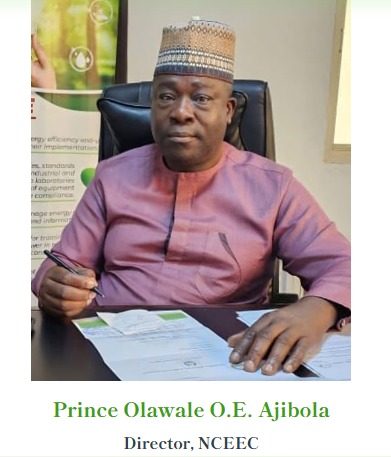
Available public records indicate that Dr Emmanuel Ogedengbe of the Department of Mechanical Engineering at the University of Lagos served as Acting Director before Dr Olawale O.E. Ajibola of the Department of Systems Engineering took over in October 2021.
Ajibola, who later became a professor, remains associated with the centre’s leadership as of 2026.
Source: Secretsreporter