
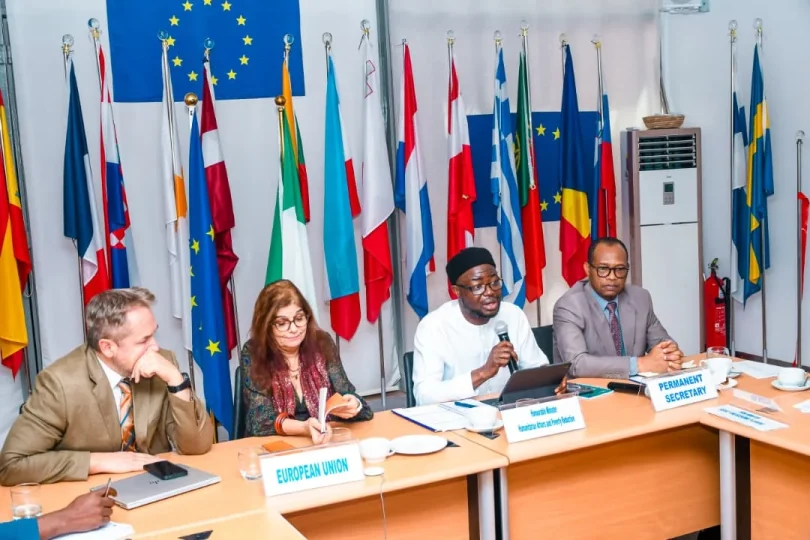
The Minister of Humanitarian Affairs and Poverty Reduction, Bernard Doro, has unveiled a major policy shift aimed at unifying Nigeria’s social welfare efforts under a single, transparent framework dubbed the “One Humanitarian, One Poverty Reduction System.”
Speaking on Monday at a High-Level Multi-Stakeholder Dialogue in Abuja, Doro emphasised that the new national platform will track and harmonise interventions across government agencies, development partners, CSOs, and the private sector.
The system is designed to provide real-time data, eliminate duplication of efforts, and ensure that financing is strictly linked to verifiable outcomes.
READ ALSO: Doro, Ribadu visit Kontagora, assure parents of safe return of abducted children
A central theme of the dialogue, organised with support from the European Union (EU), was the “imperative” of sub-national ownership.
Doro argued that State and Local Governments must lead first-line humanitarian responses because they possess the contextual knowledge and proximity required to handle crises like flooding, displacement, and insecurity effectively.
The key objectives highlighted for strengthening at the state level included improving budgeting by integrating humanitarian planning into state development frameworks, as well as establishing effective early warning systems through practical, state-led first-line response mechanisms and motivation protocols for local governments.
They also included enhancing emergency coordination by strengthening State Emergency Management Agencies (SEMAs) alongside community-based responders.
The minister also called for a shift toward Results-Based Financing (RBF).
Unlike traditional input-based funding, RBF links program financing to measurable, verified outcomes.
This approach aims to enhance accountability and promote domestic resourcmobilisationon by ensuring that every naira spent yields a tangible impact on poverty reduction.
“We must have clearly defined exit outcomes that move beneficiaries decisively out of poverty,” Doro stated, stressing that progress will be “incremental and stepwise” but achievable through collective action.
Supporting the call for collaboration, the Minister of Budget and National Planning, Atiku Bagudu, noted that humanitarian action and poverty reduction are embedded in Nigeria’s constitutional principles.
He highlighted that recent macro-economic reforms have increased fiscal inflows to states and LGAs, creating a “new opportunity” for enhanced investment in the social sector.
The EU Head of State for Human Development, Leila Ben Amor Mathieu, reaffirmed the European Union’s commitment to Nigeria’s local ownership and sustainable financing models.
READ ALSO: Tinubu appoints Ribadu, Doro, others to lead Nigeria’s delegation to US for joint security talks
The dialogue concluded with a commitment to internalise these policies ahead of the National Council on Humanitarian Affairs and Poverty Reduction scheduled for January 2026.
For more details, visit New Daily Prime at www.newdailyprime.news.