
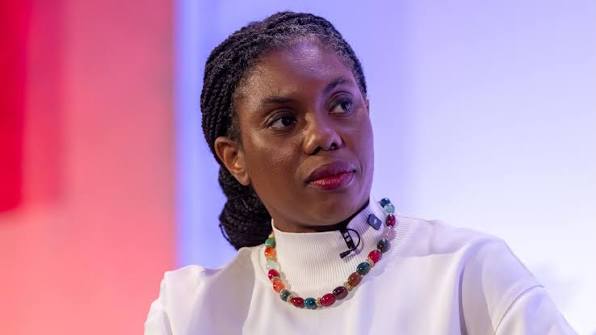
UK Conservative Party leader, Kemi Badenoch, has congratulated Andy Burnham on becoming Britain’s new Prime Minister but warned that the country requires a leader willing to make difficult decisions rather than someone focused on pleasing everyone.
Burnham officially took office on Monday after succeeding Sir Keir Starmer, prompting reactions from across Britain’s political divide.
In a statement shared on her official X account, Badenoch wished the new prime minister success, saying the country needs a government fully focused on addressing the issues that matter most to the British public.
“Today, Britain has a new Prime Minister. I wish Andy Burnham every success because we need a Prime Minister and a Government focused on fixing the public’s priorities,” she said.
While extending her congratulations, Badenoch made it clear that her role as Leader of the Opposition would be to scrutinise Burnham’s administration rather than offer unconditional support.
According to her, she would commend the government whenever it made the right decisions but would not hesitate to challenge policies she considered harmful.
“My job as Leader of the Opposition is to hold the Prime Minister to account, not to be his cheerleader. When he does the right thing, I will praise him,” she stated.
Badenoch also welcomed reports suggesting Burnham intends to approve licences for the Jackdaw and Rosebank oil and gas fields in the North Sea.
However, she argued that approving only those projects would not go far enough in tackling Britain’s energy challenges.
The Conservative leader urged the new government to completely reverse restrictions on new oil and gas licences, insisting that increased domestic energy production would help lower energy costs for households.
“In that spirit, I welcome press reports that Burnham plans to grant licences for the Jackdaw and Rosebank gas fields in the North Sea. But he must not stop there. He should end Ed Miliband’s destructive ban on new licences altogether. Let’s get Britain drilling so we can bring down the cost of energy,” she said.
Despite congratulating Burnham, Badenoch criticised what she described as the absence of a clearly defined governing agenda.
She faulted the new prime minister for not appearing before Parliament immediately after taking office and accused him of avoiding detailed public scrutiny.
According to her, Burnham had declined calls to answer questions from Members of Parliament, meaning there would be no Prime Minister’s Questions (PMQs) until September.
She also criticised his media strategy, noting that he granted an interview to broadcaster Gary Lineker instead of facing more rigorous questioning.
“Andy Burnham is becoming Prime Minister without having set out a clear plan for government. He has refused calls to come to Parliament to answer questions from MPs, meaning there won’t be a PMQs until September. He has avoided proper media scrutiny, giving an interview instead to Gary Lineker,” Badenoch stated.
‘Britain Needs A Leader, Not A People Pleaser’
In one of the strongest remarks in her statement, Badenoch acknowledged Burnham’s personality but questioned whether it would translate into effective leadership.
“I have found Andy to be a nice man. But Britain needs a leader who can take difficult decisions, not a people pleaser,” she said.
Also Read: 2027: North not willing to support Tinubu– Dele Momodu
Badenoch also argued that Britain’s current economic problems could not be blamed solely on former Prime Minister Keir Starmer.
According to her, the challenges stemmed from Labour’s broader approach to governance.
She accused the outgoing administration of leaving behind rising welfare costs, increasing unemployment, higher energy bills and a tax burden that she claimed was slowing economic growth and worsening the cost-of-living crisis.
“The problem wasn’t just Keir Starmer; it was the whole Labour Party,” she said.
She maintained that reducing public spending, particularly on welfare, would be essential to restoring economic stability and said the Conservative Party would support the government if it pursued such reforms.
Badenoch insisted the Conservative Party had reflected on its time in government and had changed its approach on several major issues, including its net-zero policies and Britain’s relationship with the European Convention on Human Rights.
She argued that the next general election would present voters with two contrasting visions for the country’s future.
According to her, Labour under Burnham would prioritise greater state intervention and wealth redistribution, while the Conservatives would campaign on policies centred around enterprise, economic growth and personal responsibility.
Her comments came shortly after Sir Keir Starmer formally resigned as Prime Minister, declaring that “my work is done” before King Charles III invited Burnham to form a new government, officially ushering in a new chapter in British politics.