
Blood Beneath The Soil In Nigeria’s Hidden War For Mineral Wealth
By Blaise Udunze
On a daily basis, the world watches Nigeria through a familiar lens in what appears to be a gory situation. Especially in cases when the news headlines tell stories of farmer-herder clashes, bandit attacks, kidnappings, villages reduced to ashes or deserted by the dwellers, as thousands of Nigerians have been displaced across states such as Zamfara, Plateau, Benue, Niger, Kaduna and Nasarawa. Subliminally, this is about to become a similarly ugly occurrence in southwestern Nigeria, which is fast becoming obvious if not nipped in the bud quickly.
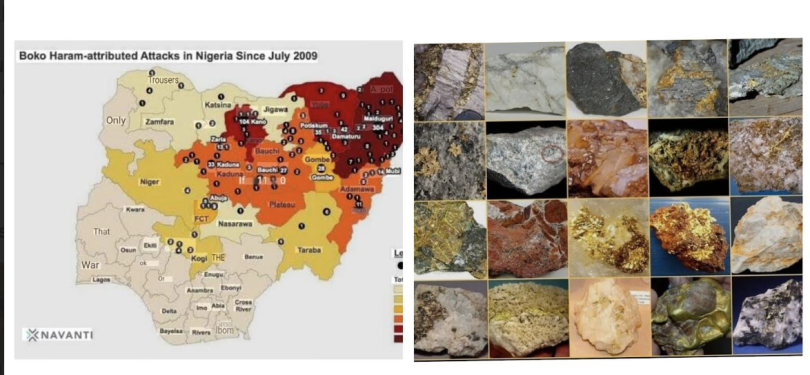
Recorded data have shown that bandits, Boko Haram, others killed over 190,000 Nigerians in 17 years and displaced 3.7 million people.
A human rights organisation, the International Society for Civil Liberties and Rule of Law (Intersociety), in its fearful revelation has said that no fewer than 190,150 Nigerians have been killed by bandits, Boko Haram insurgents, and suspected armed herdsmen between July 2009 and March 19, 2026 as this call for concern.
The dominant explanations often point to ethnic tensions, religious divisions, climate change, shrinking grazing routes or weak security institutions. No doubt, those factors are certainly part of Nigeria’s complex security crisis. Yet another question deserves serious examination.
What if, in some locations, the violence is also serving another purpose? What if some of the territories experiencing repeated displacement are the same places sitting atop some of Nigeria’s most valuable mineral deposits? More importantly, if such a pattern exists, who benefits when communities disappear?
Of a truth, these questions are uncomfortable, but undeniably they deserve careful investigation rather than dismissal.
For ages, Nigeria has been naturally endowed and it is estimated to be rich in enormous significant reserves of gold, lithium, uranium, tin, columbite and other strategic minerals increasingly sought after in the global transition to clean energy technologies. As international demand for battery minerals continues to rise, these resources have become far more valuable than they were only a decade ago.
If one overlays publicly available geological information with maps showing persistent violence, some observers argue that striking geographical overlaps appear in several regions. Such overlaps alone cannot establish causation. Correlation is not proof of conspiracy. However, they raise questions worthy of independent scrutiny.
One issue attracting increasing attention and adequately yearns for answer is whether prolonged insecurity may inadvertently or deliberately create conditions that make mineral extraction easier.
Under Nigeria’s Nigerian Minerals and Mining Act 2007, mineral resources belong to the Federal Government, while mining rights are granted through licences and leases. Community engagement and land access are expected to form part of the licensing process, although implementation varies depending on circumstances. This raises an important policy question.
What happens when the communities expected to participate in those processes have already fled because of violence?
Displacement changes the dynamics of land ownership, consent and access. While no evidence automatically proves that attacks are orchestrated to facilitate mining, the sequence of violence followed by renewed commercial activity in some locations deserves closer examination by regulators, lawmakers and investigative journalists.
In conflict studies, researchers have long observed that wars often generate economic winners alongside humanitarian losers. Could elements of Nigeria’s insecurity also be producing economic beneficiaries?
Reports over the years have documented concerns about illegal mining operations across parts of northern Nigeria. Government agencies themselves have repeatedly acknowledged that criminal networks profit from the country’s vast mineral wealth. The unresolved question is whether isolated criminality has, in some instances, evolved into more sophisticated alliances involving political influence, financial interests and international supply chains. If so, the implications extend far beyond Nigeria.
Invariably, it is clearly known that lithium has become one of the world’s most strategic commodities, powering electric vehicle batteries and renewable energy storage systems. Gold has always remained one of the safest global investment assets during periods of uncertainty. Meanwhile, it is well confirmed that the global appetite for these minerals creates enormous financial incentives.
Suppose violent displacement reduces resistance to extraction. Suppose shell companies subsequently acquire mining interests. Suppose minerals then leave Nigeria through legitimate-looking export documentation while their true value remains understated.
These scenarios remain allegations unless supported by verifiable evidence. Yet they outline a framework that investigators may wish to test rather than ignore. Financial crime experts frequently identify trade mis-invoicing as one of the most common methods of illicit financial flows worldwide.
Could Nigeria’s solid minerals sector be vulnerable to similar practices? If valuable lithium ore is deliberately but inaccurately described as lower-value material on export documents, substantial wealth could potentially leave the country without reflecting its true market value. Likewise, if unrefined gold exits through privileged channels with limited scrutiny, questions naturally arise about oversight, transparency and accountability over criminal activities which have continued to stunted and disrupt the country’s socio-economic growth and at the same time cause carnage.
Such possibilities are not accusations against any particular institution or company. Rather, they illustrate why stronger monitoring systems are increasingly essential. Another question concerns logistics.
With the high level of criminal activities, industrial mining requires heavy machinery, diesel supplies, transportation networks and specialised personnel. These are not operations that can remain invisible indefinitely.
If certain territories are genuinely too dangerous for security agencies, how do industrial-scale extraction activities reportedly continue in some remote locations? If they do, who protects those operations? Who authorises their movement? Who verifies what is extracted? Who ensures royalties and export revenues reach public coffers? These are governance questions that demand institutional answers.
Equally important is the international dimension. Minerals extracted in Nigeria ultimately enter global supply chains. Gold may pass through international refining hubs before entering financial markets. Lithium may become part of battery manufacturing destined for electric vehicles, which are facts as they are sold across Europe, North America and Asia.
One known fact is that consumers purchasing products containing these minerals rarely know the full story of where they originated.
Increasingly, however, investors and governments are demanding ethical sourcing standards that trace minerals from extraction to final manufacture.
A critical factor that must be taken into cognizance is that if insecurity is creating opportunities for illegal or unethical extraction anywhere in the world, multinational companies have responsibilities alongside national governments, of which the onus falls on the Nigerian government.
Transparency cannot stop at the mine gate. Nor should accountability end at national borders. Another issue requiring attention concerns beneficial ownership.
Across many jurisdictions, shell companies can obscure the identities of individuals ultimately controlling commercial assets. If politically exposed persons or powerful business interests are hidden behind complex corporate structures registered offshore, identifying beneficiaries becomes significantly more difficult. This challenge is hardly unique to Nigeria.
Findings showed that from Latin America to Central Africa and Southeast Asia, resistant corporate networks have frequently complicated efforts to combat corruption and illicit resource extraction. That is precisely why open corporate registries, beneficial ownership databases and transparent mining licence disclosures are becoming global governance priorities. For Nigeria, the stakes could hardly be higher.
The country stands at the centre of the world’s emerging critical minerals economy. The Nigerian government can’t feign ignorance of the fact that, when handled transparently, these resources could finance infrastructure, education, healthcare, and industrial development for generations.
In no way would the government claim not knowing that when handled poorly, they risk becoming another chapter in the well-documented “resource curse,” where extraordinary natural wealth coincides with persistent poverty, insecurity and institutional weakness.
The ultimate challenge, therefore, is not simply about mining. It is about governance. It is about whether public institutions possess both the independence and capacity to ensure that natural resources benefit citizens rather than narrow interests. It is about whether conflict zones receive genuine peacebuilding efforts instead of becoming forgotten frontiers. And it is about whether international markets demand accountability with the same enthusiasm they demand raw materials.
None of these questions should be answered through speculation. They require rigorous investigations, forensic financial analysis, satellite imagery, mining license audits, customs records, beneficial ownership disclosures and courageous journalism.
They require governments willing to open their books. They require international cooperation capable of tracing money across borders. Most importantly, they require asking questions that have too often remained unasked.
Perhaps Nigeria’s security crisis is exactly what it appears to be: a tragic convergence of historical grievances, weak institutions, criminality and environmental pressures. Or perhaps, in some places, another layer of economic incentive deserves closer scrutiny.
Until those questions are thoroughly investigated, one possibility will continue to linger. Maybe the world’s attention has been fixed on the blood spilled above ground, while too little attention has been paid to the extraordinary wealth lying beneath it.
Blaise, a journalist and PR professional, writes from Lagos and can be reached via: [email protected]