
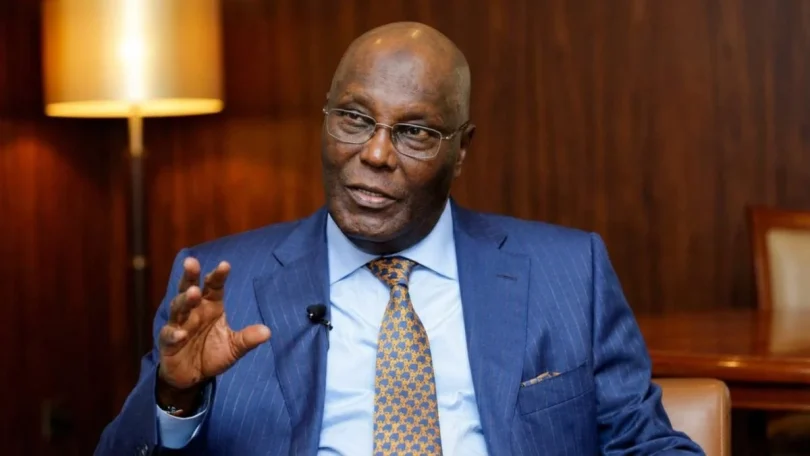
A proposal by former Vice President Atiku Abubakar’s campaign to restore fuel subsidy and bring petrol down to between ₦400 and ₦500 per litre could cost Nigeria about ₦88.1 billion daily and ₦32.2 trillion annually, according to an analysis of the production-subsidy model.
Dino Melaye, Deputy Director-General for Contact and Mobilisation in Atiku Abubakar’s 2027 Presidential Campaign Council, said on AIT’s Democracy Today that the proposed return of subsidy could reduce petrol from about ₦1,400 to between ₦400 and ₦500 per litre.
Using crude at $100 per barrel, an exchange rate of ₦1,350/$ and assumed domestic refining capacity of 740,500 barrels per day, the analysis estimates that crude would have to be supplied to participating refiners at about $11.82 per barrel to support a ₦500 pump price, assuming other costs remain unchanged.
That represents an 88 per cent discount on a barrel worth $100 internationally.
The size of that discount creates another problem. Access to crude at barely one-tenth of its international value would make refinery licences and crude allocations extremely valuable, potentially encouraging a scramble to participate in the programme and creating opportunities for arbitrage, diversion and rent-seeking.
Nigeria has been here before. In 2001, domestic crude was supplied at about a 61 per cent discount to international value, while the estimated reduction in the final petrol price was only about 28 per cent.
The fiscal trade-off would also be enormous. The estimated ₦32.2 trillion annual cost is larger than the entire ₦32 trillion capital budget for 2026, nearly 13 times the ₦2.48 trillion health allocation and more than nine times the ₦3.52 trillion education allocation. It is equivalent to about 47 per cent of the entire ₦68.3 trillion federal budget and 87 per cent of projected Federal Government revenue.
There could also be consequences for the naira. Nigeria earns foreign exchange from crude exports. Diverting large volumes of crude from export sales into the domestic market at an 88 per cent discount would reduce potential dollar earnings. All else equal, lower foreign-exchange inflows would mean less supply of dollars to the economy and could place renewed pressure on the exchange rate and external reserves.
Financing such a large subsidy through additional borrowing or monetary expansion could create further macroeconomic pressure, potentially feeding back into inflation, interest costs and the exchange rate.
The ₦32.2 trillion figure is a scenario estimate, not a costing released by the Atiku campaign. The eventual cost would depend on crude prices, exchange rates, volumes supplied, refinery utilisation and the structure of the programme.
The campaign has yet to explain how much crude would receive preferential pricing, who would qualify for allocations, how diversion would be prevented, or how the programme would be financed.