
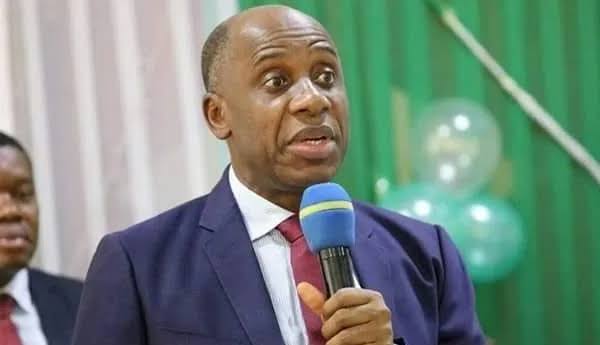
Former Minister of Transportation and ex-Governor of Rivers State, Rotimi Amaechi, has firmly ruled out the possibility of serving as a vice-presidential candidate in the 2027 general elections, declaring that he is not suited to play second fiddle to any presidential aspirant.
Amaechi made the statement while speaking at a public event in Abuja, amid growing political speculation that he could emerge as a running mate to former Vice-President Atiku Abubakar, who is believed to be positioning himself as the presidential flagbearer of the African Democratic Congress (ADC).
Putting the rumours to rest, Amaechi stated unequivocally that he has no intention of deputising for any candidate, regardless of political alignment or personal relationship. According to him, his political experience and convictions make such an arrangement impractical.
“I will not be vice president to anybody. There are too many reasons why I won’t be vice president to anybody,” Amaechi said. “The first reason is that I’m too presidential to be vice.”
READ ALSO; Amaechi faults FG’s response to school abductions, says children deserve urgent protection
The former minister, who is also reportedly nursing his own presidential ambition under the ADC platform, argued that the challenges associated with the office of the vice president in Nigeria go beyond personal preference. He described the position as structurally flawed, insisting that it is not merely ceremonial but fundamentally constrained by the constitutional and political framework of governance.
Amaechi maintained that, in practice, the Nigerian vice presidency is designed to be subordinate and largely dependent on the disposition of the president. According to him, this arrangement often leaves vice presidents marginalised, with limited authority and influence over governance.
“The problem with the office of the vice president is not about the person occupying it, it is structural,” he explained. “In Nigeria, the vice president is often powerless and must rely entirely on the temperament of the president.”
Drawing from his years of experience in public office, Amaechi warned that such an imbalance could easily lead to friction at the highest level of government. He suggested that disagreements between a president and vice president are almost inevitable under the current system, particularly when both individuals possess strong political identities.
“We will quarrel,” he said bluntly. “Instead of that, I would rather be a minister than be a vice president.”
Amaechi’s remarks are likely to reshape ongoing political calculations ahead of the 2027 elections, especially within opposition circles seeking strategic alliances. By ruling out a vice-presidential role, he has positioned himself either as a potential presidential contender or a key political actor unwilling to accept a subordinate executive role.
As political realignments continue to take shape, Amaechi’s stance underscores the broader debate about the relevance, powers and effectiveness of the vice-presidential office in Nigeria’s democratic system.
For more details, visit New Daily Prime at www.newdailyprime.news