
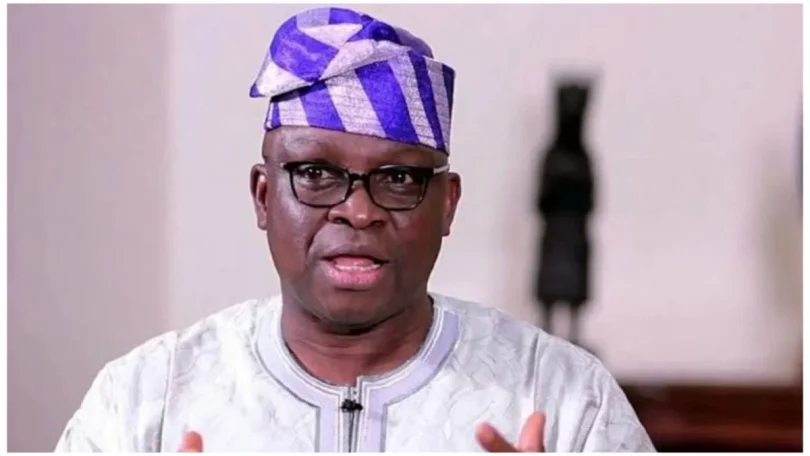
Former governor Ayodele Fayose of Ekiti state has alleged that the Accord Party spent no less than N40 billion during the August 15 governorship election in Osun State.
His claim directly contradicts a position earlier expressed by Afrobeats star, David Adeleke, popularly known as Davido, who said the All Progressives Congress spent heavily on vote-buying while the Accord Party relied on the people to secure victory.
Davido, a nephew of Governor Ademola Adeleke, had alleged that APC spent about N110 billion on vote-buying during the election.
But Fayose, speaking in an interview with TVC journalist, Nifemi Oguntoye, said both major contenders committed substantial financial resources to the election.
According to him, the Accord Party’s expenditure alone could not have been below N40 billion.
“Accord Party led the opponents. The money that went to that election from the Accord Party itself cannot be under N40 billion. I stand to be corrected,” Fayose said.
He further alleged that more than N7.5 billion was transferred to various local governments and wards shortly before the election, with some wards allegedly receiving about N35 million..
The former governor said the scale of spending by the two leading parties went beyond the legally prescribed limits for election expenditure, arguing that neither side could claim to have won solely through popular support or other non-financial factors.
He also questioned why the alleged disbursements were made shortly before the election rather than months earlier, particularly in view of the Economic and Financial Crimes Commission’s action on some accounts.
“Why don’t you send those to the people six months ago?” he asked.
Despite his criticism of the spending pattern, Fayose said the financial allegations did not explain away the outcome of the election.
He pointed instead to the voting strength of the Adeleke family in Ede as a major factor behind the 66,252-vote difference between Governor Adeleke and APC candidate Bola Oyebamiji.
Adeleke secured 511,067 votes, while Oyebamiji polled 444,815 votes.
Fayose argued that the Adeleke political structure in Ede gave the Accord candidate a substantial advantage that the APC could not easily neutralise.
He estimated that the governor’s advantage in Ede alone accounted for about 46,000 votes.
“The Adelekes are rooted in their hometown. Omisore or APC has no presence,” he said, arguing that changing APC’s candidate would not necessarily have altered the outcome.
Fayose consequently urged APC to approach the courts if it believed the election figures were questionable.
“I think they should go to court,” he said.
He also claimed that he suspected irregularities in the votes recorded in Ede, although he did not provide evidence for the allegation.
“I believe it was pirated. That’s what I believe,” Fayose said.
The former governor further dismissed the argument that President Bola Tinubu’s administration worked against APC during the election, saying the President could have exerted greater influence if he had wanted to determine the outcome.
In another interview, Fayose said the Osun result should not be interpreted as a major boost for the opposition ahead of the 2027 presidential election.
According to him, opposition politicians have already lost valuable time by failing to consolidate their efforts into a single political platform.
He particularly ruled out an easy path to victory for presidential candidates Atiku Abubakar of the African Democratic Congress and Peter Obi of the Nigeria Democratic Congress.
Fayose said the two opposition figures could only make significant progress if they were able to unite, describing such a development as requiring a “miracle.”
“In the presidential election, Obi has lost already; Atiku has lost already. Except there is a miracle of them coming together, there is no headway,” he said.
He also claimed that the decision by Rabiu Kwankwaso to serve as Obi’s running mate had generated resentment in parts of the North, particularly Kano.
“In Kano, a lot of people are aggrieved that Kwankwaso is deputising Obi,” Fayose said.
The former governor further argued that the opposition had little time left to engineer a comprehensive alliance, noting that political parties had already advanced through the electoral process.
He dismissed recent withdrawals and late political realignments as ineffective, saying attempts to build a united opposition at this stage would amount to too little.