
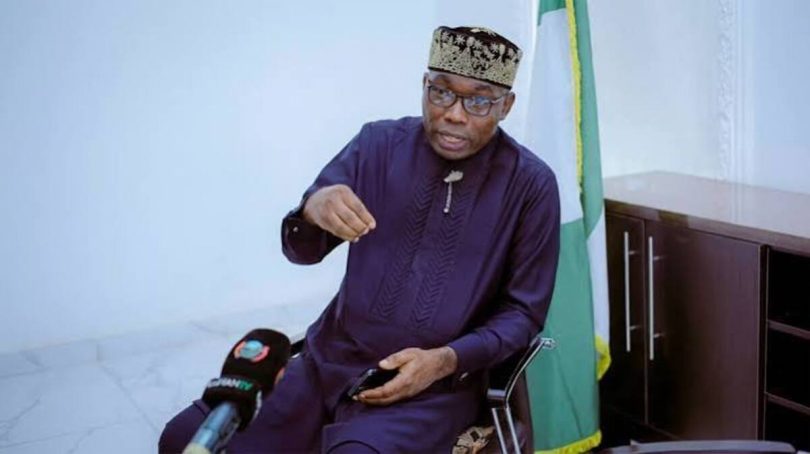
The presidential candidate of the Social Democratic Party (SDP), Prince Adewole Adebayo, has unveiled an economic blueprint aimed at transforming Nigeria from an import-dependent economy into a production-driven economy within four years.
Adebayo, in his economic plan, titled “Farewell to Poverty and Insecurity,” proposed sweeping reforms in agriculture, manufacturing, electricity, automobile production, small and medium-scale enterprises, and the financial sector.
He said the plan was anchored on five principles: self-reliance and import substitution, full employment and poverty elimination, balanced regional development, speedy implementation, and strategic government intervention where private investment was inadequate.
According to him, Nigeria must move away from what he described as “palliative economics” and focus on building productive capacity and generating sustainable wealth.
Adebayo argued that the country could not continue to manage poverty through consumption and short-term interventions, stressing that economic policy should instead focus on creating jobs and expanding domestic production.
At the centre of the blueprint is an agricultural strategy involving expanded irrigation, mechanisation, improved seeds, fertiliser access, credit, and extension services.
The SDP candidate also proposed the establishment of agro-processing hubs across the six geopolitical zones to ensure that agricultural produce is processed locally and converted into higher-value products.
Manufacturing, he said, would serve as the engine of industrialisation, with regional industrial clusters developed around areas of comparative advantage, including agro-processing, textiles, pharmaceuticals, automobile assembly, electronics, and building materials.
Adebayo further proposed increased access to affordable credit, loan guarantees, and technical support for small and medium-scale enterprises, which he described as critical to expanding production and employment.
One of the most notable proposals in the blueprint is the establishment of a Bank of Electricity, which would provide long-term, single-digit-interest financing for distributed power generation.
The proposed institution would also support the local production of electricity infrastructure and equipment, including transformers, meters, cables, solar panels, and batteries.
ALSO READ: Aiyedatiwa’s aide, Yusuf urges youths to stop waiting, start building future
Adebayo said the strategy would complement the expansion of the national grid with mini-grids and embedded power generation, with the broader objective of addressing the country’s electricity deficit while creating a domestic manufacturing ecosystem around the power sector.
The SDP candidate also identified automobile imports as a major area requiring urgent policy intervention.
He argued that Nigeria’s economic policy had focused excessively on food import substitution while paying insufficient attention to the foreign exchange spent on imported vehicles.
According to him, developing a competitive domestic automobile industry would reduce pressure on foreign exchange while creating jobs and strengthening local manufacturing capacity.
Employment generation, Adebayo said, would not be treated as a by-product of economic growth but as a central objective of government policy.
He proposed dedicated programmes targeting young people, women, and SMEs, alongside measures to improve access to finance and technical support.
The blueprint also seeks to redirect the financial system towards the “real economy” through cheaper credit, stronger development-finance institutions, credit guarantees, and incentives for banks to lend more to agriculture, manufacturing, and infrastructure.
Adebayo said the overall objective was to ensure that Nigeria increasingly produced the goods and services it consumed rather than relying on imports.
He said his proposed economic transformation would be implemented within the first four years of his administration, positioning the 2027 election as a choice between continuing dependence on imported goods and embarking on what he described as a genuine industrial transformation.