
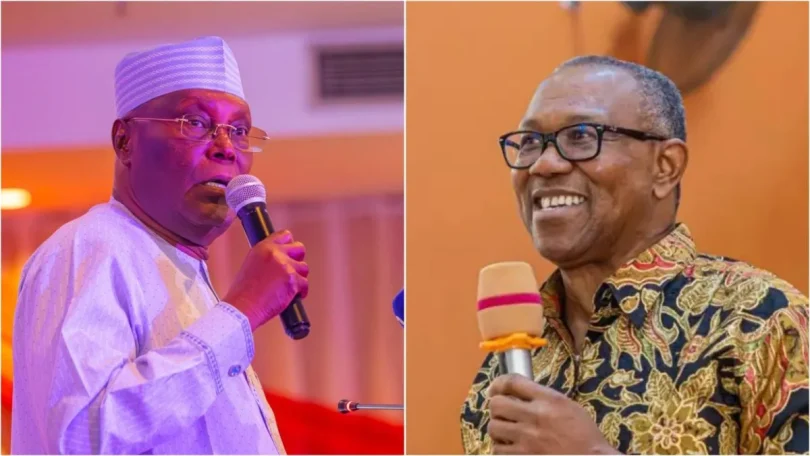
Former Vice President Atiku Abubakar and former Anambra State Governor Peter Obi are among the major opposition figures expected to meet in Abuja on Monday, August 31, as efforts to build a stronger alliance ahead of the 2027 general election.
The meeting will be convened by the G100 at the Yar’Adua Centre in Abuja.
It is expected to bring together leaders and key stakeholders from six opposition political parties for discussions on how they can work together ahead of the next presidential election.
The summit is coming at a time when opposition parties are under pressure to overcome their differences and avoid splitting their votes in the 2027 contest.
The meeting is themed “A Framework for Opposition Cooperation and Coordination.”
It is expected to provide a formal platform for discussions on the terms, principles and structures that could guide cooperation among the participating parties.
The parties involved are the African Democratic Congress (ADC), Allied Peoples Movement (APM), Nigeria Democratic Congress (NDC), Peoples Democratic Party (PDP), Peoples Redemption Party (PRP) and Social Democratic Party (SDP).
Atiku is currently the presidential candidate of the ADC, while Obi is the presidential candidate of the NDC.
However, the proposed cooperation is not expected to immediately settle the question of who will fly a joint presidential ticket.
The G100 has made it clear that the immediate objective of the summit is to create a structure through which the participating parties can negotiate their interests and possible areas of cooperation.
According to G100 convenor, Salihu Moh. Lukman, the group does not intend to force the parties into abandoning their individual identities.
“The first question before party leaders is not who leads the ticket. It is what we are, together, prepared to do for this country,” the statement said.
The position comes after several weeks of consultations between representatives of the G100 and leaders of the six political parties.
The consultations began after the group released its “Doctrine of a Necessary Democratic Opposition” on August 2, 2026.
The document called for greater cooperation among opposition forces and argued that a fragmented opposition could struggle to present a serious challenge in the 2027 election.
Lukman said the consultations were deliberately conducted away from the public spotlight because of the sensitive nature of the issues being discussed.
According to him, representatives of the G100 met with National Chairmen, presidential candidates and running mates of the parties involved.
“At the centre of the consultations was a common recognition of the need for a credible, organised and competitive democratic opposition, and a willingness to engage the difficult questions that meaningful cooperation ahead of 2027 will require,” Lukman stated.
How the opposition talks will work
The G100 is proposing the establishment of five specialised Working Groups as part of the process.
The groups, subject to approval by the participating parties, are expected to work for four weeks after the summit.
Their responsibility will be to prepare the major documents and agreements that may eventually guide cooperation between the parties.
The structure is intended to ensure that the proposed alliance does not depend only on informal discussions among individual politicians.
Instead, the G100 wants the participating parties to have a clear institutional process through which difficult issues can be discussed and resolved.
“Cooperation does not require any party to disappear into another. The first question before party leaders is not who leads the ticket. It is what we are, together, prepared to do for this country.
“The First Summit is not intended to determine, in a single sitting, questions of presidential candidacy or the final form that opposition cooperation may take. Its immediate purpose is more fundamental, to establish and authorise a formal architecture through which those questions can be negotiated collectively, transparently and in good faith.
“Each participating political party is expected to attend with a delegation of leaders and key stakeholders, drawn from its national leadership and other relevant constituencies within the party. These delegations will participate fully in the deliberations of the Summit, ensuring that the process extends beyond the principal party leaders and draws upon a broader representation of political experience, perspectives and interests.
“Among the proposals before the Summit will be the establishment of structures that will facilitate negotiations and cooperation and five specialised Working Groups. Subject to the decisions of the participating parties, these bodies will be mandated to develop, within four weeks, the principal documents and agreements required to give institutional form to opposition cooperation,” the statement added.
The expected delegations will include National Working Committee members and other key representatives of the six parties.
Presidential candidates and their running mates are also expected to participate in the summit.
Atiku and Obi’s positions
The planned summit comes against the backdrop of continuing disagreement over the possibility of a single opposition presidential candidate.
Atiku and Obi have both remained open to opposition cooperation, but neither political camp has indicated that its principal candidate is prepared to automatically withdraw from the presidential race.
The issue has become one of the most difficult questions surrounding the proposed coalition.
Atiku contested the 2023 presidential election under the PDP and later emerged as the ADC’s candidate for the 2027 election.
Obi, who was Atiku’s running mate during the 2019 presidential election, contested the 2023 election under the Labour Party before moving towards the NDC platform.
Their political relationship has therefore remained an important part of discussions about a possible opposition alliance.
The NDC has previously indicated that it would prefer Obi to lead any coalition that eventually adopts a consensus presidential candidate.
“We have made the point clear that we should choose the best candidate in the opposition and we in the NDC believe that Peter Obi is the best if he is allowed to lead the coalition. This is our position.”
Atiku’s emergence as the ADC presidential candidate has further complicated the possibility of a simple arrangement between the two camps.
Rather than immediately forcing a decision on the ticket, the G100 now wants the parties to first agree on a framework for cooperation.