
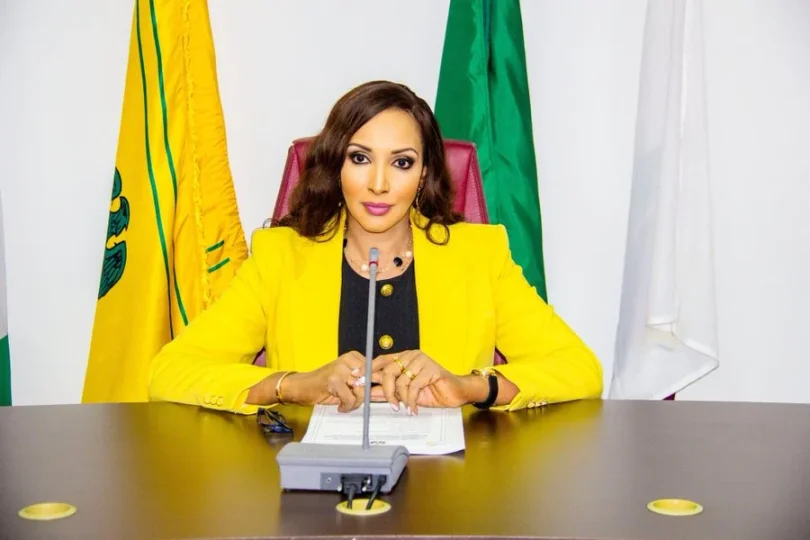

The Minister of Foreign Affairs, Ambassador Bianca Odumegwu-Ojukwu, has urged foreign diplomatic missions in Nigeria to exercise restraint in their comments on the country’s 2027 general elections, warning against “unguarded comments, disparaging remarks, or unsolicited lectures on democracy.”
Ojukwu made the remarks while interacting with members of the Diplomatic Corps in Abuja, where she said the Federal Government was committed to delivering a peaceful, free, fair and credible election.
She said Nigeria’s position as Africa’s largest democracy meant that developments in the country had regional and international implications, requiring foreign missions to be guided in their public interventions.
“Also, as the 2027 general elections draw near, the Ministry of Foreign Affairs would request that missions remain guided,” she said.
“Recognising the fact that Nigeria is the largest democracy in Africa, and that developments in Nigeria have regional and international complications and implications, we would not look kindly upon unguarded comments, disparaging remarks, or unsolicited lectures on democracy.”
According to her, the government of President Bola Ahmed Tinubu was committed to democracy and to conducting an election that would be peaceful, free, fair and credible “in all ramifications.”
The minister said the engagement with the Diplomatic Corps was also aimed at strengthening communication, mutual understanding and partnership between the Ministry of Foreign Affairs and foreign missions accredited to Nigeria.
“This is because diplomacy functions best where communication is open, trust is mutual, and engagement is continuous,” she said.
Ojukwu assured the diplomatic community that the Ministry remained open to addressing concerns affecting their missions, saying: “The Ministry of Foreign Affairs is your diplomatic home in Nigeria.”
She urged diplomatic missions to use established channels in communicating with the Nigerian government, including the Presidency, ministries, departments and agencies, saying the Ministry remained the official channel of communication between foreign missions and the Federal Government.
“This is not intended to impede access or to create unnecessary bureaucracy. Rather, it ensures proper coordination, consistency, and effective follow-up,” she said.
The minister added that diplomatic missions were expected to respect Nigeria’s institutional processes in the same manner Nigerian diplomatic missions respected the channels of host governments.
“Let me emphasize that the Ministry is not an obstacle between you and the Nigerian Government; we are your bridge to the Nigerian Government,” she said.
On Nigeria’s foreign policy, Ojukwu said the Tinubu administration remained committed to the “4Ds” of Demography, Development, Democracy and Diaspora, with emphasis on economic diplomacy, investment, trade, technology, infrastructure and engagement with Nigerians abroad.
She said Nigeria would continue to pursue strategic autonomy in its international relations while maintaining cooperation with other countries based on national interest, mutual respect, reciprocity and international obligations.
“Strategic autonomy does not mean isolation; it means preserving Nigeria’s sovereign right to determine the relationships and positions that best serve our people,” she said.
Ojukwu also called for the revitalisation of outstanding Joint Commissions and Bi-National Commissions, saying the mechanisms could be used to deepen cooperation in trade, investment, security, education, technology, health and agriculture.
She further appealed to foreign missions to review their visa processes for Nigerian applicants, particularly long waiting periods affecting legitimate travellers, students, businesspeople and families.
While acknowledging the sovereign right of countries to determine their visa policies, she called for greater efficiency, transparency and responsiveness.
The minister assured members of the Diplomatic Corps that the safety and welfare of foreign diplomats and their families remained a priority of the Nigerian government.
She said Nigeria would continue to engage with ECOWAS, the African Union, United Nations, the Commonwealth and other international institutions, while advocating greater African participation in shaping global decisions.
Ojukwu said the meeting marked the beginning of closer engagement between the Ministry and the Diplomatic Corps, stressing that diplomatic relations should ultimately produce tangible benefits for the peoples of the countries involved.