
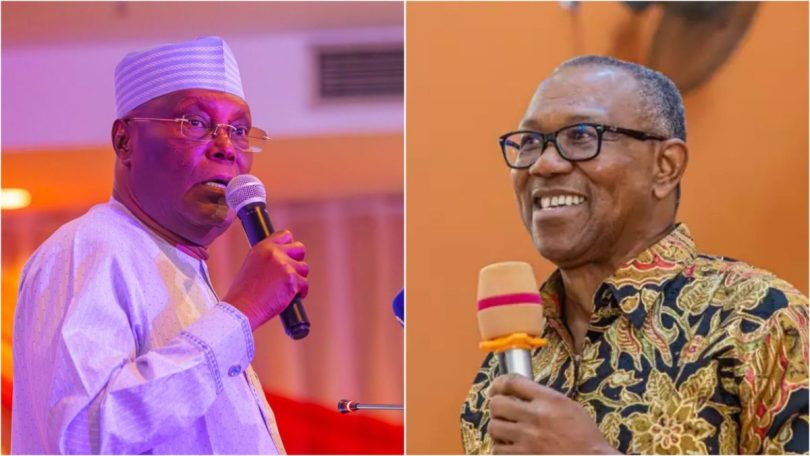
A political strategist and Convener of the League of Northern Democrats, Umar Ardo, has identified the political ambitions of former vice president Atiku Abubakar and Peter Obi as major obstacles to the formation of a united opposition coalition ahead of the 2027 presidential election.
Ardo said while Atiku, the presidential candidate of the African Democratic Congress (ADC), may retain his support base if he decides to withdraw from the race, he is unlikely to make such a concession.
According to him, Obi, who is presidential candidate of the Nigeria Democratic Congress (NDC), appears more capable of stepping aside for a consensus candidate, but doing so could cost him the backing of his supporters.
The political strategist made the remarks while speaking on Arise News, where he assessed the prospects of opposition parties and politicians seeking to challenge President Bola Tinubu in 2027.
Ardo said, “My view is that Atiku does not have the propensity by himself to say, ‘I will step down.’ If he says so, he will not have a problem with his support base. But the issue is that he is highly unlikely to say that.
“Then Peter Obi has the propensity to say, ‘I will step down.’ But if he says so, he will not have his support base. He will not be able to carry his support base. His support base will not go with him.”
He described the contrasting positions as two major challenges that must be resolved before a credible opposition merger can emerge.
“Unless we are able to resolve these two challenges, then I don’t see the fusing together being possible,” Ardo said.
He, however, maintained that the failure of Atiku and Obi to merge would not necessarily eliminate their chances of defeating the incumbent, arguing that either politician could upset the existing political order if properly positioned.
“Even if they don’t fuse together, they still have the capacity to win the election against the incumbent on an individual basis,” he added.
The debate over an opposition alliance has intensified following moves by opposition leaders to build a platform capable of challenging Tinubu and the ruling All Progressives Congress (APC) in 2027.
Atiku and Obi had initially been part of efforts to build an opposition coalition under the ADC. However, Obi subsequently moved towards the NDC after expressing reservations about the coalition’s proposed primary process.
The two politicians have a history of working together. Obi was Atiku’s running mate on the platform of the Peoples Democratic Party (PDP) in the 2019 presidential election before leaving the party ahead of the 2023 election to contest under the Labour Party.
Meanwhile, another opposition coalition leader, Salihu Lukman, has argued that the outcome of the recent Osun State governorship election demonstrates that opposition parties can defeat the APC in 2027 if they overcome their internal divisions.
Reacting to the victory of Governor Ademola Adeleke, Lukman said the election had provided a practical template for opposition parties seeking to unseat Tinubu.
He argued that the opposition’s major problem was not a lack of popular support but fragmentation among its leaders and political platforms.
“Nigeria’s opposition does not suffer from a shortage of popular support. Its greatest challenge is fragmentation,” Lukman said.
He urged opposition leaders to put aside individual ambitions and party interests, stressing that the country’s political future should take precedence over the aspirations of individual candidates.
“Nigeria is bigger than any candidate, any ambition and any political party. If opposition leaders genuinely believe that the country requires a different direction in 2027, then they must demonstrate the same courage, restraint and willingness to compromise that has now produced this outcome in Osun,” he stated.