
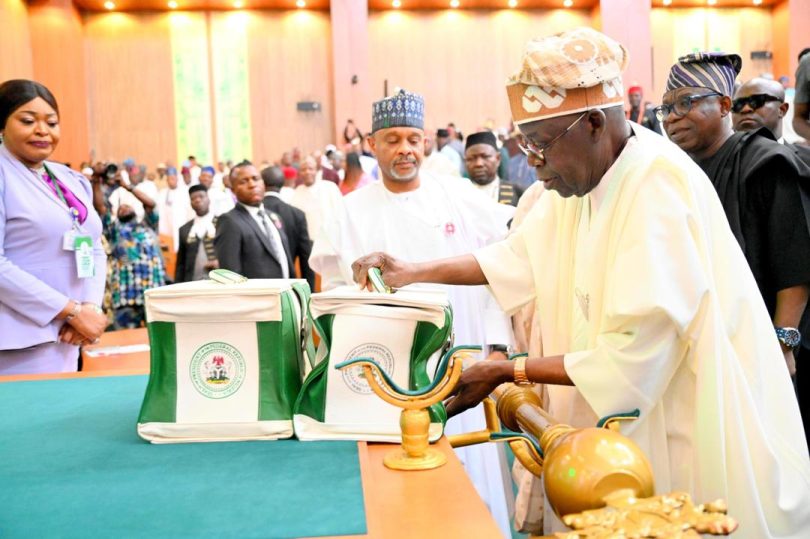
Presented by:
His Excellency, Asiwaju Bola Ahmed Tinubu, GCFR
President, Federal Republic of Nigeria, At the Joint Session of the National Assembly, Abuja, Friday, 19 December 2025
PROTOCOLS
o Distinguished Senate President,
o Rt. Honourable Speaker and Honourable Members of the House of Representatives,
o Distinguished Senators and Honourable Members of the National Assembly,
o Fellow Nigerians,
1. I am here today to fulfil an essential constitutional obligation by presenting the 2026 Appropriation Bill to this esteemed Joint Session of the National Assembly for your consideration.
2. This budget represents a defining moment in our national journey of reform and transformation. Over the last two and a half years, my government has methodically confronted long‑standing structural weaknesses, stabilised our economy, rebuilt confidence, and laid a durable foundation for the construction of a more resilient, inclusive, and dynamic Nigeria.
3. Though necessary, the reforms have not been painless. Families and businesses have faced pressure; established systems have been disrupted; and budget execution has been tested. I acknowledge these difficulties plainly. Yet, I am here, today, to assure Nigerians that their sacrifices are not in vain. The path of reform is seldom smooth, but it is the surest route to lasting stability and shared prosperity.
4. Today, I present a Budget that consolidates our gains, strengthens our resilience, and takes this country from out of the dark tunnel of hopelessness, from survival to growth.
5. The 2026 Budget is themed: “Budget of Consolidation, Renewed Resilience and Shared Prosperity”. It reflects our determination to lock in macroeconomic stability, deepen competitiveness, and ensure that growth translates into decent jobs, rising incomes, and a better quality of life across for every Nigerian.
6. Mr. Chairman, Leaders of the National Assembly, while the global outlook continues to improve, this Budget aims to further strengthen our Nigerian economy to benefit all our citizens.
7. I am encouraged that our reform efforts are already yielding measurable results:
1) Our economy grew by 3.98 per cent in Q3 2025, up from 3.86 per cent in Q3 2024.
2) Inflation has moderated for eight consecutive months, with headline inflation declining to 14.45 per cent in November 2025, from 24.23 per cent in March 2025. With stabilising food and energy prices, tighter monetary conditions, and improving supply responses, we expect the deflationary trend to persist over the 2026 horizon, barring major supply shocks.
3) Oil production has improved, supported by enhanced security, technology deployment, and sector reforms.
4) Non‑oil revenues have expanded significantly through better tax administration.
5) Investor confidence is returning, reflected in capital inflows, renewed project financing, and stronger private‑sector participation.
6) Our external reserves rose to a 7‑year high of about US47 billion dollars as of last month, providing over 10 months of import cover and a more substantial buffer against shocks.
8. These outcomes are not accidental or lucky. They are the consequence of our difficult policy choices. Our next objective is to deepen our gains in pursuit of enduring and inclusive prosperity.
9. Mr. Chairman, Distinguished Members, our 2025 budget implementation faced the realities of transition and competing execution demands. As of Q3 2025, we recorded:
· 18.6 trillion naira in revenue — representing 61% of our target; and
· 24.66 trillion naira in expenditure — representing 60% of our target.
10. Following the extension of the 2024 capital budget execution to December 2025, a total of 2.23 trillion naira was released for the implementation of 2024 capital projects as of June 2025.
11. While fiscal challenges persisted, the government met its key obligations. However, only 3.10 trillion naira — about 17.7% of the 2025 capital budget — was released as of Q3, reflecting the emphasis on completing priority 2024 capital projects during the transition period.
12. Let me be clear: 2026 will be a year of stronger discipline in budget execution. I have issued directives to the Honourable Minister of Finance and Coordinating Minister of the Economy, the Honourable Minister of Budget and Economic Planning, the Accountant‑General of the Federation, and the Director‑General of the Budget Office of the Federation to ensure that the 2026 Budget is implemented strictly in line with the appropriated details and timelines.
13. We expect improved revenue performance through the new National Tax Acts and the ongoing reforms in the oil and gas sector — reforms designed not merely to raise revenue, but to drive transparency, efficiency, fairness, and long‑term value in our fiscal architecture.
14. I have also provided clear and direct guidance regarding Government‑Owned Enterprises. Heads of all agencies have been directed to meet their assigned revenue targets. To support this, we will deploy end‑to‑end digitisation of revenue mobilisation — standardised e‑collections, interoperable payment rails, automated reconciliation, data‑driven risk profiling, and real‑time performance dashboards — so leakages are sealed, compliance is verifiable, and remittances are prompt. These targets will form core components of performance evaluations and institutional scorecards. Nigeria can no longer afford leakages, inefficiencies, or underperformance in strategic agencies. Every institution must play its part.
15. Mr Chairman and fellow Nigerians, the 2026 Budget is guided by four clear objectives:
1) Consolidate macroeconomic stability;
2) Improve the business and investment environment;
3) Promote job‑rich growth and reduce poverty; and
4) Strengthen human capital development while protecting the vulnerable.
16. In short: we will spend with purpose, manage debt with discipline, and pursue broad-based, sustainable growth.
17. Distinguished Members, the 2026 Federal Budget is anchored on realism, prudence, and growth.
18. The key aggregates are as follows:
1) Expected total revenue is 34.33 trillion naira.