
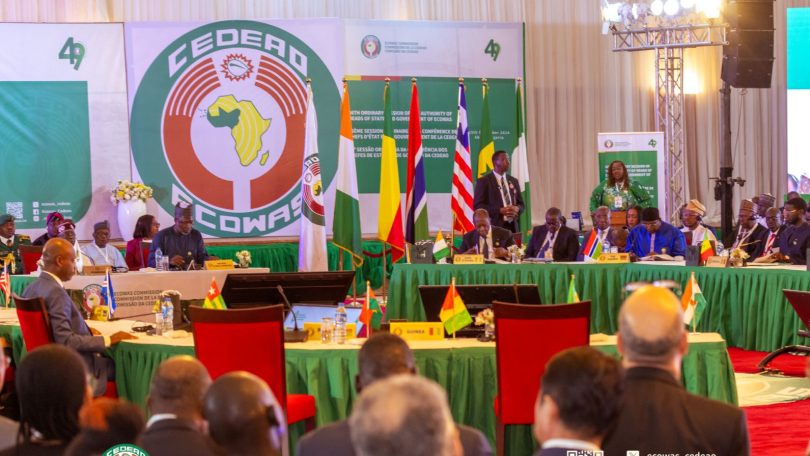
The Economic Community of West African States ECOWAS has declared a region-wide state of emergency.
The announcement came on Tuesday during the 55th Session of the Mediation and Security Council at ministerial level in Abuja.
ECOWAS Commission President, Omar Touray, warned that the situation demands urgent collective action.
He said the region faces rising political instability, expanding security threats and growing humanitarian pressures.
Rising Fears Over West Africa’s Stability
Touray told ministers and diplomats that West Africa is now rated “high risk” after a review of security and political developments in each member state.
He said the region must confront the “imperative of serious introspection” and act fast to defend democracy and protect citizens.
He listed several troubling issues, including repeated military interventions in member states, stalled political transitions and shrinking electoral participation.
According to him, the “persistence of military interventions” in places like Guinea-Bissau and the Republic of Benin shows that democratic gains remain fragile.
Elections Now a Major Trigger
Touray warned that elections have increasingly become flashpoints for instability.
He also raised concerns about terrorism, cross-border crime and geopolitical pressure affecting regional unity.
Declaring the situation unprecedented, he said, “Faced with this situation, Excellencies, it is safe to declare that our community is in a state of emergency.”
Security Council to Meet More Often
Touray recommended more frequent meetings of the Mediation and Security Council over the next year.
He said ECOWAS must “pool our resources” to fight terrorists, armed groups and bandits operating across borders.
He listed priority areas such as the Guinea-Bissau crisis, monitoring political transitions, tackling political exclusion and protecting regional cohesion.
Humanitarian Situation Worsens
Touray cited new UNHCR figures showing that 7.6 million people are forcibly displaced across West Africa.
Nigeria, Burkina Faso, Niger and Mali have the largest displaced populations, while Niger, Mali, Nigeria, Côte d’Ivoire and Togo host most asylum seekers.
He said ECOWAS must “take decisions and actions that will reverse this trend.”
ECOWAS Reassures Citizens
Touray pledged that ECOWAS remains committed to promoting peace and stability.
“Let me assure our community citizens that we will not rest on our oars,” he said.
He urged members to uphold constitutional norms and protect regional unity.
Touray also welcomed Nigeria’s new Defence Minister, Rtd. General Christopher Musa, and Cabo Verde’s Foreign Affairs Minister, José Luis Livramento.
Sierra Leone Calls for Strong Action
Sierra Leone’s Foreign Affairs Minister and Chair of the Council, Timothy Kabba, called for firm steps to protect democracy.
He said the recent events in Guinea-Bissau and Benin show the weakness of democratic structures in the region.
“The recent coup in Guinea-Bissau and the attempted coup in the Benin Republic are sobering reminders of the fragility of our democratic gains,” he said.
Kabba said he led a delegation to Guinea-Bissau on 1 December to engage with the military and political groups.
He said the mission helped reduce tension and opened the door for further dialogue.
He noted that ECOWAS “cannot and will not accept” actions that threaten peace, stability and democracy.
Citizens Expect Real Results
Kabba urged ministers to deliver concrete outcomes.
He said West Africans “no longer have patience for commitments that remain unfulfilled.”
The Mediation and Security Council meeting comes before the summit of ECOWAS Heads of State, who will review the recommendations as pressure mounts to restore stability.
Region Under Mounting Strain
West Africa is facing rising coups, attempted coups and unstable transitions.
Mali, Niger and Burkina Faso remain under military rule.
Guinea-Bissau recently joined this list, and an attempted coup in Benin on Sunday highlighted the deepening crisis.
These developments underline the erosion of democratic norms and the increasing influence of armed groups and criminal networks across the region.