
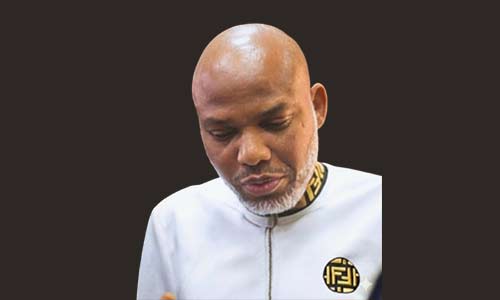
The Abuja Division of the Court of Appeal on Friday struck out an appeal filed by the convicted leader of the Indigenous People of Biafra, Nnamdi Kanu, challenging alleged violations of his fundamental rights by the Federal Government.
The Director General of the Department of State Services and the Attorney General of the Federation were listed as respondents.
A three-member panel of the appellate court dismissed the appeal on the grounds that it had been overtaken by events, noting that Kanu had already been convicted and sentenced by the Federal High Court in Abuja.
Delivering the lead judgment, Justice Boloukuromo Ugo held that the appeal had become an academic exercise since Kanu was no longer in DSS custody but is now serving his sentence at the Sokoto Correctional Centre.
Justice Ugo noted that Kanu’s lawyer, Maxwell Opara, confirmed during proceedings that his client is being held at the correctional facility, rendering the request for his transfer from DSS custody to Kuje prison irrelevant.
He added that Kanu had previously expressed preference for prison custody, a situation now satisfied by his conviction and lawful remand.
The Court of Appeal therefore struck out the case for want of merit.
Kanu had appealed the July 3 ruling of Justice Taiwo Taiwo, who dismissed his fundamental rights enforcement suit for lack of proof.
In the original suit filed in December 2021, marked FHC/ABJ/CS/1585/2021, Kanu alleged that his health had deteriorated in DSS custody and claimed that the medical personnel attending to him were unqualified. The DSS, through counsel Idowu Awo, argued that no evidence was provided to substantiate the claim that its medical staff were “quacks.” The AGF, represented by Simon Enoch, also urged the court to dismiss the application.
Justice Taiwo ruled that Kanu failed to prove allegations of torture, denial of religious freedom, or inadequate medical care, stressing that no medical expert was called to support the claims. The court further held that a detainee’s right to practise religion must not infringe on the rights or peace of others in custody.
On November 20, the Federal High Court convicted Kanu on a seven-count terrorism charge after finding that the prosecution proved its case beyond reasonable doubt. Justice James Omotosho sentenced him to life imprisonment.